Can the Tejas Mk-1A Really Close the Indian Air Force’s Fighter Gap?
The Indian Air Force (IAF) faces one of the most significant force-structure challenges in its modern history. Against an authorised strength of 42 combat squadrons, it currently operates only around 29–31 squadrons, leaving a deficit of roughly 11 to 13 squadrons.
The retirement of the final MiG-21 Bison squadrons in 2025 marked the end of an iconic chapter in Indian military aviation. It also exposed a stark reality: while ageing aircraft could no longer remain in service indefinitely, their retirement widened an already serious numerical gap.
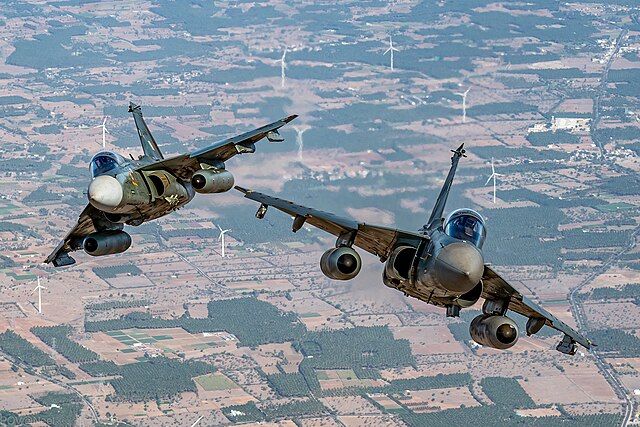
The Tejas Mk-1A now sits at the centre of the IAF’s recovery strategy. With 180 aircraft on order, it is expected to become the backbone of India’s light fighter fleet over the coming decade.
But can one aircraft programme reverse years of declining squadron strength?
The answer is yes—but only partly.
Understanding the Scale of the Challenge
A typical IAF fighter squadron consists of 16 to 18 aircraft. An 11–13 squadron deficit therefore translates into a shortage of roughly 200–230 fighters.
This is more than a numerical concern.
India must simultaneously deter China along the northern frontier and Pakistan on the western front, requiring sufficient combat mass to sustain operations across multiple theatres. While both neighbours continue modernising their air forces, maintaining adequate squadron strength has become increasingly urgent.
For decades, the MiG-21 helped maintain fleet numbers despite its ageing design. Its retirement removed an aircraft that had long exceeded its intended service life but still contributed significantly to the IAF’s order of battle.
Replacing those numbers has become one of the service’s highest priorities.
What Makes the Tejas Mk-1A Different?
The Tejas Mk-1A is far more than an incremental upgrade over the original Tejas Mk-1.
Designed as a modern 4.5-generation light multi-role fighter, it combines improved survivability, advanced sensors, network-centric capabilities and lower maintenance requirements.
| Capability | Tejas Mk-1A | Operational Benefit |
|---|---|---|
| Radar | AESA Radar (EL/M-2052 initially, Uttam AESA in future batches) | Greater detection range and multi-target engagement |
| Air-to-Air Weapons | Astra Mk-1 BVR missile and ASRAAM | Strong beyond-visual-range and close-combat capability |
| Electronic Warfare | Advanced Self-Protection Jammer and Digital RWR | Improved survivability in contested airspace |
| Air Refuelling | Fixed refuelling probe | Extended combat radius and endurance |
| Maintainability | Modular LRUs and redesigned access panels | Faster turnaround and higher sortie generation |
| Indigenous Content | More than 60%, increasing over time | Reduced import dependence and stronger domestic industry |
Compared with the MiG-21, the Mk-1A offers dramatically improved situational awareness, greater combat flexibility and significantly higher operational availability.
However, modern capability alone does not solve a force-structure problem.
Aircraft must also be delivered quickly enough to replace retiring fleets.
Production: The Real Test
This is where the programme faces its greatest challenge.
HAL has expanded production from two assembly lines in Bengaluru to a three-line manufacturing network with the addition of its Nashik facility.
| Production Facility | Assembly Lines | Annual Capacity | Status |
|---|---|---|---|
| Bengaluru | 2 | ~16 aircraft | Operational |
| Nashik | 1 | ~8 aircraft | Operational |
| Total | 3 | ~24 aircraft annually | Expansion underway |
HAL aims to eventually increase output to 30 aircraft per year, supported by an expanding private-sector supply chain.
Companies including Larsen & Toubro, Dynamatic Technologies, Tata Advanced Systems and Alpha Design now manufacture major structural assemblies, fuselage sections and avionics, helping distribute production across India’s aerospace industry.
The principal bottleneck, however, remains the GE F404-IN20 engine.
Delays in engine deliveries have slowed aircraft induction and shifted operational timelines. Until engine supply stabilises, production capacity alone cannot translate into faster squadron induction.
Even at a sustained production rate of 24 aircraft annually, delivering all 180 ordered fighters will take several years, meaning the programme’s full impact will only become evident toward the end of the decade.
Why the Tejas Mk-1A Cannot Solve the Problem Alone
The IAF’s future force structure is designed around a balanced mix of light, medium and heavy fighters.
The Tejas Mk-1A replaces the MiG-21’s role but cannot substitute for larger aircraft capable of carrying heavier payloads over greater ranges.
Consequently, several parallel modernisation programmes are progressing simultaneously.
| Programme | Planned Scale | Primary Role | Timeline |
|---|---|---|---|
| Tejas Mk-1A | 180 aircraft | Light multi-role fighter | 2026–2032 |
| Super-30 Upgrade | Existing Su-30MKI fleet | Heavy air superiority and deep strike | Ongoing |
| MRFA | 114 aircraft (proposed) | Medium multi-role capability | Late 2020s onwards |
| Tejas Mk-2 | 4–5+ squadrons | Medium-weight indigenous fighter | Early 2030s |
| AMCA | Around 7 squadrons | Fifth-generation stealth fighter | Mid-to-late 2030s |
The upgraded Su-30MKI fleet will continue serving as the IAF’s principal air dominance platform, while the MRFA programme is intended to restore medium-weight capability. Beyond that, the Tejas Mk-2 and AMCA represent the next stages of India’s long-term aerospace roadmap.
What the Next Decade Could Look Like
Assuming production remains on schedule, squadron recovery is likely to follow a gradual trajectory:
- 2026–2027: First operational Tejas Mk-1A squadron enters service.
- 2028–2030: Regular deliveries begin replacing retired aircraft at scale.
- 2030–2032: Combined effect of Tejas Mk-1A inductions and Super-30 upgrades begins improving operational strength.
- 2032–2035: Tejas Mk-2 and potential MRFA inductions accelerate recovery.
- Beyond 2035: AMCA introduces fifth-generation capability.
Even under favourable conditions, restoring the authorised strength of 42 combat squadrons will remain a long-term objective rather than an immediate milestone.
A more realistic near-term goal is stabilising the fleet at 35–36 squadrons during the early 2030s.
Conclusion
The Tejas Mk-1A is neither a silver bullet nor merely a symbolic indigenous programme.
It is the cornerstone of the Indian Air Force’s immediate force-rebuilding strategy.
By replacing the MiG-21 with a far more capable platform, strengthening India’s aerospace manufacturing ecosystem and laying the industrial foundation for future programmes such as the Tejas Mk-2 and AMCA, the Mk-1A provides the IAF with its most practical path toward rebuilding combat strength.
Ultimately, the programme’s success will depend less on its design—which is already proven—and more on execution.
Sustained engine availability, predictable production rates, robust private-sector participation and continued investment in future fighter programmes will determine whether India merely arrests its squadron decline or finally begins reversing it.
The coming decade will therefore test not only the Tejas Mk-1A itself, but India’s ability to transform indigenous aerospace ambition into sustained operational capability.
The aircraft has already demonstrated what it can do. The challenge now is producing enough of them, quickly enough, to reshape the Indian Air Force.