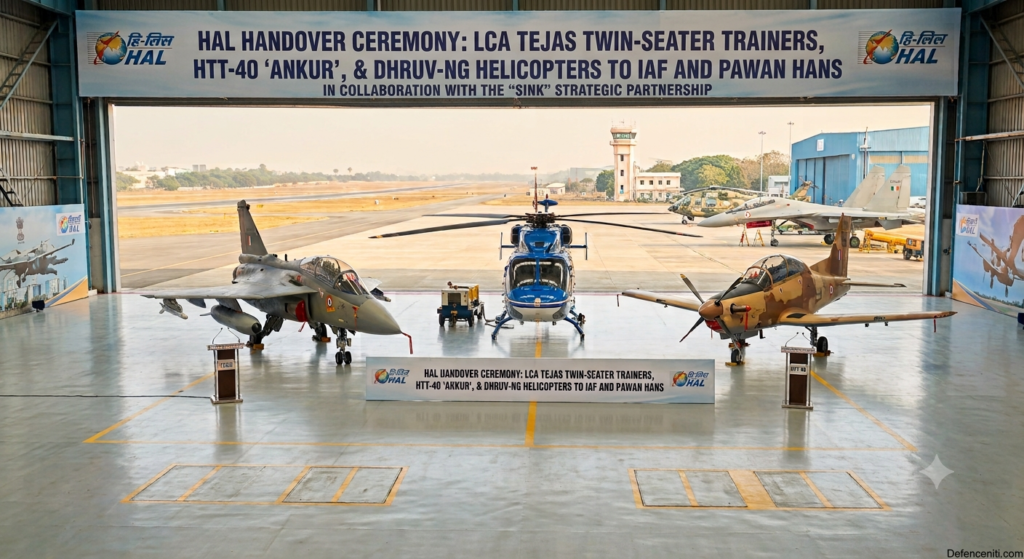
On 18 September 2026, Hindustan Aeronautics Limited (HAL) marked a significant day in India’s aerospace journey at its Bengaluru facility. In the presence of Defence Minister Rajnath Singh and Civil Aviation Minister K. Rammohan Naidu, HAL formally handed over two Light Combat Aircraft (LCA) Tejas Final Operational Clearance (FOC) twin-seater trainers and three HTT-40 basic trainer aircraft to the Indian Air Force (IAF). Simultaneously, four Dhruv Next Generation (NG) helicopters were delivered to Pawan Hans Limited (PHL).
The ceremony, which included a traditional pooja, was attended by Chief of the Air Staff Air Chief Marshal A.P. Singh, Secretary (Defence Production) Sanjeev Kumar, Secretary (Civil Aviation) Samir Kumar Sinha, HAL Chairman and Managing Director Ravi K, and senior officials from the Ministry of Defence, IAF, regulators, and industry partners.
Defence Minister Rajnath Singh described the event as far more than a routine handover. “Today is not merely about a handover ceremony; it represents a significant milestone in our progress towards indigenous aerospace capabilities, technological self-confidence, and Atmanirbhar Bharat,” he stated. He also emphasised the need for greater public-private synergy and realistic project timelines, noting that delays can escalate costs and risk technological obsolescence.
Completing the Tejas FOC Twin-Seater Chapter
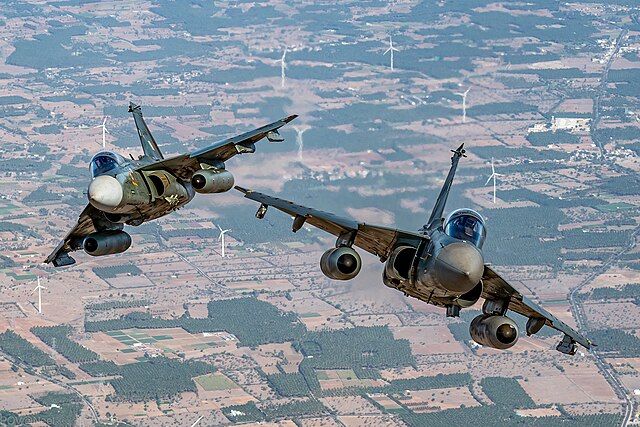
The two LCA Tejas FOC twin-seater trainers delivered on the day represent the final aircraft under the FOC contract. This completes the supply of all four twin-seaters ordered as part of the broader LCA Mk1 programme (16 single-seat fighters and four trainers).
These aircraft retain the core systems and combat capabilities of the operational Tejas while being optimised for pilot training. They enable a seamless indigenous training continuum, allowing young pilots to transition from basic trainers directly onto a platform that closely mirrors the frontline fighter they will eventually fly. The FOC configuration incorporates improved radar performance, enhanced autopilot and fuel systems, Software Defined Radio for secure communications, and an air-to-air refuelling probe on later aircraft.
With the delivery of these final two trainers, HAL has successfully closed the original LCA Mk1 order of 40 aircraft (placed in two phases in 2006 and 2010). This achievement underscores the maturity of India’s fighter aircraft design and production ecosystem, even as the larger Tejas Mk1A programme continues to face engine and integration challenges.
HTT-40 ‘Ankur’: Ending Dependence on Imported Basic Trainers
Perhaps the most symbolic delivery of the day was the first three series-production HTT-40 basic trainers, officially named ‘Ankur’ by the Defence Minister. This marks the beginning of deliveries under the Ministry of Defence’s contract for 70 aircraft, valued at approximately ₹6,838 crore.
Designed and developed by HAL’s Aircraft Research and Design Centre, the HTT-40 is a tandem-seat, turboprop aircraft powered by a Honeywell TPE331-12B engine (1,100 shp). It offers excellent low-speed handling characteristics and supports the full spectrum of basic pilot training — aerobatics, instrument flying, navigation, night flying, and close formation flying. With a maximum speed of around 300 knots, a service ceiling of 6,000 metres, and an endurance of approximately three hours, the aircraft is well-suited to the IAF’s primary training requirements.
India had long relied on imported platforms such as the Pilatus PC-7 Mk II and earlier Hawk trainers for basic flying instruction. The induction of the HTT-40, which currently has about 57% indigenous content (with plans to push beyond 60%), represents a decisive step towards eliminating this dependency. HAL has established production lines at both Bengaluru and Nashik with a combined capacity of up to 20 aircraft per year. The first three aircraft (two from Bengaluru and one from Nashik) were ready after the arrival of the initial batch of Honeywell engines earlier in 2026. Under the technology transfer arrangement, HAL will eventually manufacture the majority of the remaining engines in India.
Dhruv NG: Expanding Indigenous Civil Rotary-Wing Capabilities
The four Dhruv Next Generation helicopters handed over to Pawan Hans mark the induction of the civil-certified variant into commercial service. The 5.5-tonne twin-engine multi-role helicopter features a modern glass cockpit, advanced avionics, enhanced navigation systems, and improved situational awareness.
Configured for civilian operations, these helicopters will support passenger transport, emergency medical services, and offshore logistics. The delivery highlights HAL’s growing ability to design and certify platforms that meet both military and civil regulatory standards, further strengthening India’s dual-use aerospace ecosystem.
Strategic Significance and the Road Ahead
This triple handover — fighter trainers, basic trainers, and civil helicopters — from a single HAL stage demonstrates the depth of capability the organisation has built over decades. It also reflects the strengthening of the wider indigenous aerospace supply chain involving private industry partners.
For the Indian Air Force, the Tejas FOC trainers and HTT-40s directly address critical gaps in the pilot training pipeline at a time when the service is working to rebuild squadron strength towards the authorised 42 combat squadrons. A robust, indigenous training continuum reduces costs, improves availability, and builds operational familiarity with Indian-designed systems from the earliest stages of a pilot’s career.
Defence Minister Rajnath Singh used the occasion to underline the importance of realistic timelines and closer collaboration between public sector units and private industry. His call for synergy aligns with broader government efforts to accelerate programmes such as Tejas Mk1A, Tejas Mk2, and the Advanced Medium Combat Aircraft (AMCA).
Looking forward, sustained production of the HTT-40, progressive induction of Tejas Mk1A fighters, and the eventual entry of Tejas Mk2 will be essential to closing the IAF’s fighter gap. At the same time, the civil success of Dhruv NG opens pathways for greater commercial helicopter exports and domestic civil aviation self-reliance.
The 18 September 2026 ceremony was more than a delivery event. It was a visible demonstration that India’s aerospace industry is steadily transitioning from dependence to design leadership, from import reliance to indigenous production, and from isolated platforms to a comprehensive training and operational ecosystem. In the journey towards Atmanirbhar Bharat in defence and aerospace, days like this matter.