MQ-1C Gray Eagle Deal: 87 UAVs to Supercharge IAF Surveillance
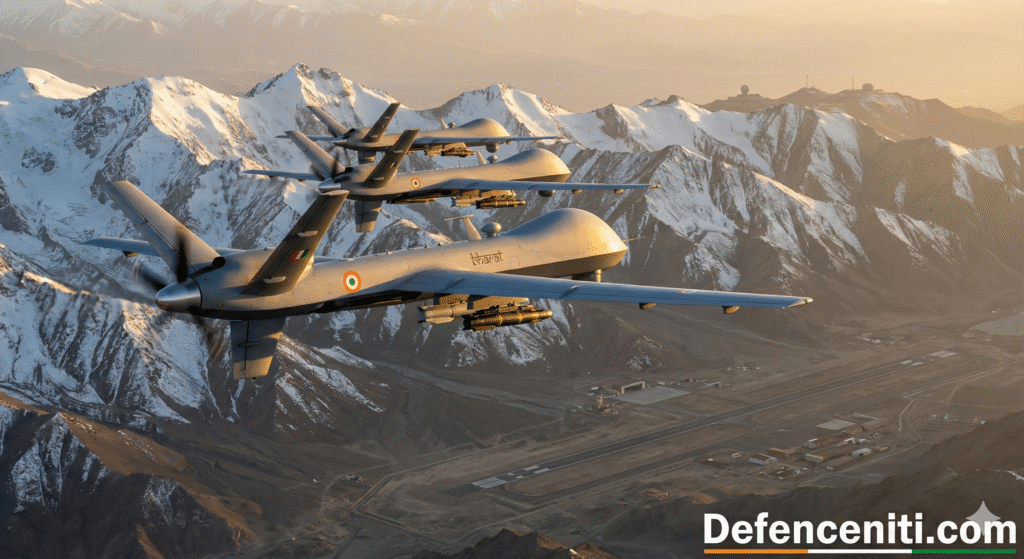
In one of the largest unmanned aerial systems acquisitions in Indian history, the Ministry of Defence has issued formal acceptance of necessity (AoN) for 87 MQ-1C-26M Gray Eagle extended-range drones for the Indian Air Force. The $3.4-billion deal, cleared under the fast-track Foreign Military Sales (FMS) route, includes 87 airframes, 48 ground control stations, 170 Hellfire missiles, 240 Stinger air-to-air missiles, and a comprehensive 12-year logistics and training package from General Atomics Aeronautical Systems Inc (GA-ASI).
The decision, finalised at the Defence Acquisition Council meeting on December 6, 2025, ends a decade-long debate over whether India should wait for fully indigenous MALE/HALE UAVs or acquire proven off-the-shelf systems to plug immediate operational gaps along the LAC and LoC. With China fielding over 300 GJ-11 stealth UCAVs and Pakistan rapidly expanding its Bayraktar and Wing Loong fleets, the IAF convinced the government that waiting for DRDO’s TAPAS-BH-201 (still stuck at 28,000 ft ceiling) or Archer-NG (first flight only in 2027) was no longer viable.
Why the MQ-1C Gray Eagle Was Chosen
- Endurance: 40+ hours (Block 26M standard)
- Ceiling: 29,000 ft (easily clears Himalayan ridges)
- Payload: 488 kg internal + 680 kg external (four Hellfire or eight Stinger)
- Sensor suite: Raytheon MTS-E electro-optical/infrared ball with SAR/GMTI radar
- Satellite communication: Beyond-line-of-sight control from mainland India even when operating over Gilgit-Baltistan or Aksai Chin
Crucially, the U.S. has agreed to integrate Indian payloads — BEL’s Bharani-II active phased-array radar, DRDO’s Uttam AESA nose radar derivative, and indigenous anti-jam SATCOM — making this the first Gray Eagle variant co-developed with a non-NATO partner.
Deployment Blueprint
- 36 UAVs → Northern Command (Leh, Nyoma, Thoise) for 24×7 LAC surveillance
- 24 UAVs → Eastern Command (Assam, Arunachal) supporting Mountain Strike Corps
- 15 UAVs → Western Air Command (LoC and Punjab border)
- 12 UAVs → Andaman & Nicobar Command for maritime ISR in the Malacca Strait
The first squadron will stand up at the newly activated Nyoma Advanced Landing Ground in eastern Ladakh by late 2027 — the same base that was operationalised in November 2025 as part of India’s high-altitude push. Read how Nyoma is transforming eastern Ladakh’s airpower.
The Gray Eagle will work in tandem with the Army’s recently inducted Ashni drone platoons, providing real-time targeting data for Pinaka-ER and BrahMos strikes. See the Army’s new border arsenal in action.
Indigenisation & Private Sector Role
Under the “Gray Eagle – India Unique” configuration:
- Tata Advanced Systems will manufacture composite wings and tail assemblies in Hyderabad
- Dynamo Aviation (Adani–Elbit JV) will set up a full MRO hub in Nagpur
- 60 % of avionics and mission computers to be produced by Bharat Electronics and Data Patterns
This mirrors the private-sector momentum seen in recent DRDO tech transfers. DRDO’s SAMANVAY 2025 is accelerating exactly this kind of industry partnership.
The deal also aligns perfectly with the 15-Year Defence Roadmap (ICDP 2025–2040), which explicitly calls for rapid induction of AI-enabled autonomous systems while indigenous programmes mature. Full details of the ICDP 2025–2040.
Political & Strategic Messaging
By choosing the FMS route over a commercial sale, the U.S. has signalled that India is now treated as a “Major Defense Partner-plus”. The inclusion of Stinger missiles — previously denied — indicates Washington’s acceptance of India’s need for armed overwatch along the LAC, especially after the 2025 Galwan-II border flare-up.
In conclusion, the 87 Gray Eagles do not just fill a capability gap — they represent a strategic pivot. By 2029, the IAF will possess a persistent, armed, high-altitude ISR-strike complex that no other regional power can match. While DRDO continues work on TAPAS, Ghatak, and SWiFT stealth UCAVs, the Gray Eagle ensures India will not fight the next border war blind.