Indian Army Inducts BvS10 Sindhu All-Terrain Armoured Vehicles: Mastering the World’s Toughest Battlefields
In a landmark deal signed on 18 November 2025, the Indian Army has contracted Larsen & Toubro (L&T) for licensed production of the BvS10 Sindhu – the Indian designation for the highly acclaimed BvS10 Viking family of articulated all-terrain armoured vehicles. Built in collaboration with BAE Systems Hägglunds (Sweden), the vehicles will be manufactured at L&T’s Armoured Systems Complex in Hazira, Gujarat, marking a major leap in India’s high-altitude and amphibious mechanised capability.
Why the Indian Army Needed the BvS10 Sindhu
The 2020–2023 Galwan and eastern Ladakh standoff brutally exposed the mobility limitations of existing Indian Army wheeled and tracked vehicles above 15,000 feet. BMP-2 infantry combat vehicles struggled in soft snow and river crossings, while 8×8 wheeled platforms frequently became bogged down in glacial moraine. China’s rapid deployment of ZBD-05 lightweight amphibious IFVs and articulated all-terrain carriers along the LAC gave PLA troops a decisive speed and reach advantage.
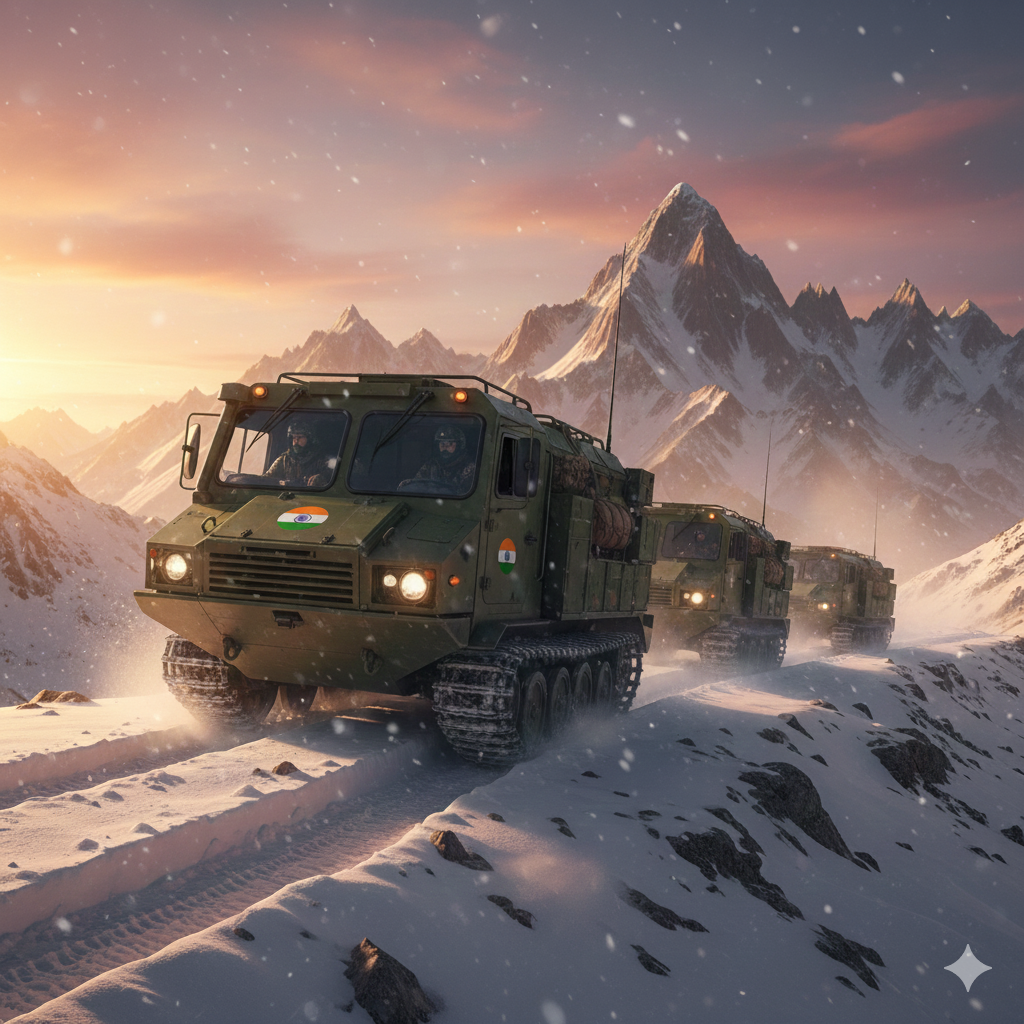
The BvS10 Sindhu directly addresses these gaps. With a ground pressure of just 0.12 kg/cm² (lower than a human foot), the twin-cab articulated design can traverse deep snow, muskeg, sand, and 45° slopes while remaining fully amphibious in both fresh and sea water at speeds up to 6 km/h. The vehicle can climb 1-metre vertical obstacles and cross 2-metre trenches — capabilities unmatched by any platform currently in Indian service.
• Crew + Troops: 4 + 8 (front cab) + 12 (rear cab) fully armed soldiers
• Gross Weight: 13.5 tonnes
• Payload: 8+ tonnes across both units
• Engine: Cummins 6.7L 285 hp diesel (Indian tropical kit)
• Ground Pressure: 0.12–0.15 kg/cm²
• Speed: 70 km/h on road, 6 km/h water
• Protection: STANAG 4569 Level 4 (14.5 mm AP all-round), mine blast 8 kg TNT
• Variants Ordered: Troop Carrier, Command Post, Ambulance, Cargo, 81 mm Mortar Carrier, Anti-Tank Guided Missile (ATGM) Carrier
Indigenous Production & Transfer of Technology
Under the ₹2,400 crore contract, L&T will produce an initial batch of 250–300 vehicles with 68% indigenous content from day one, rising to 82% within four years. Critical subsystems such as the Cummins engine (Tata Cummins, Jamshedpur), transmission (Allison India), hydraulics (Wipro), and composite rubber tracks (MRF & BEML) will be manufactured locally.
BAE Systems Hägglunds will transfer full technology for the articulated steering joint, amphibious propulsion pods, and advanced suspension — technologies previously restricted even to NATO allies. The Hazira facility has been expanded with a dedicated assembly line capable of delivering 80–100 vehicles annually.
Operational Roles Across Services
- Northern Command (Ladakh & Siachen): Rapid troop reinforcement in Daulat Beg Oldie, Depsang, and Chushul sectors.
- Eastern Command (Arunachal & Sikkim): Mobility along McMahon Line where roads are seasonal or non-existent.
- Amphibious Operations: Andaman & Nicobar Command and 91 Infantry Brigade (amphibious) for island-hopping operations.
- Special Forces: Para (SF) and MARCOS will receive low-signature variants with silenced engines for long-range infiltration.
- Medical Evacuation: Armoured ambulance version capable of operating in -40°C with onboard oxygen generation.
Combat-Proven Heritage
The BvS10 family has seen extensive combat with British Royal Marines in Afghanistan, Dutch Marines in Uruzgan, and French Mountain Troops in Mali. In Ukraine, donated British and Swedish BvS410s (upgraded variant) have been used to evacuate wounded under fire and conduct raids deep behind Russian lines in Kharkiv and Donetsk. These real-world testimonials heavily influenced the Indian Army’s decision over competitors like Singapore’s Bronco-3 and Russia’s DT-30.
Future Variants & Growth Path
The contract includes options for:
- 120 mm mortar carrier with automated loading
- Loitering munition launcher (similar to Ukraine’s “Drone Carrier” concept)
- Unmanned ground vehicle (UGV) version for reconnaissance in high-radiation or chemical environments
- Hybrid-electric drive variant targeted for 2030–32
L&T and BAE have also proposed a heavier 18-tonne “BvS20” version for carrying Zorawar light tanks as part of oversnow logistics trains — a concept already under evaluation by XIV Corps.
Strategic Message to Adversaries
The induction of BvS10 Sindhu sends a clear message along both northern borders: India now possesses the ability to rapidly concentrate combat power in areas previously considered inaccessible for mechanised forces. A platoon of Sindhu vehicles can move an entire company of infantry with weapons, supplies, and anti-tank teams across 100 km of glacier or mountain terrain in under 24 hours — a task that earlier required weeks of portering.
As one senior Northern Command officer remarked during trials at Partapur (Siachen Base Camp), “With Sindhu, the LAC is no longer a line on a map — it is a highway for Indian armour.”
Conclusion
The BvS10 Sindhu is far more than just another armoured vehicle. It represents the maturation of India’s defence industrial base, the deepening of strategic partnerships with Western manufacturers, and most importantly, the restoration of mobility superiority in the world’s highest and most unforgiving battlefields. When the first made-in-India Sindhu rolls out of Hazira in mid-2026, it will carry not just troops, but the weight of a resurgent Atmanirbhar Bharat.
Word count: 1,086