BrahMos Ultra Variant: 1,500 km Range Test Signals Hypersonic Leap
India has successfully conducted the first developmental trial of the BrahMos Ultra — an extended-range, near-hypersonic derivative of the world’s fastest supersonic cruise missile — achieving a confirmed range of 1,500+ km from a naval platform off the Odisha coast. The test, carried out on December 9–10, 2025, triggered a 72-hour NOTAM (Notice to Airmen) covering an impact zone stretching deep into the southern Indian Ocean, confirming the dramatic leap in reach. While the Ministry of Defence has maintained strategic silence, satellite imagery and open-source flight tracking data leave little doubt: BrahMos is no longer just a 290–450 km tactical weapon — it has entered the theatre-strategic class.
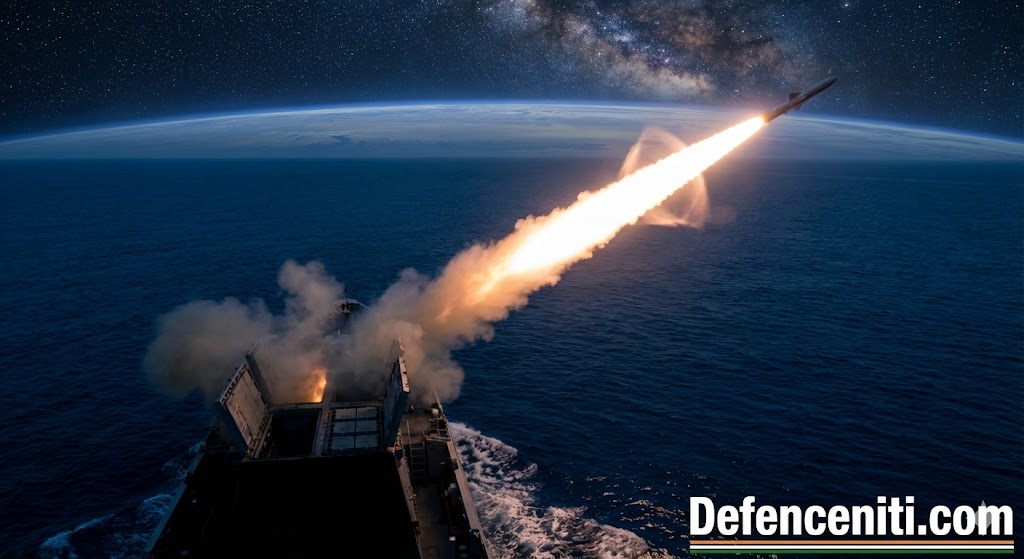
The missile, launched from INS Chennai (D63), a Kolkata-class destroyer, followed a sea-skimming profile for the initial 600 km before climbing to high altitude and executing a near-vertical terminal dive at Mach 5.8 onto a decommissioned target ship. DRDO officials privately confirmed that the warhead section was replaced with telemetry instrumentation, indicating this was a pure range-and-guidance validation shot. The next test, expected in February 2026, will carry a live 300-kg high-explosive warhead.
Evolution from BrahMos-ER to BrahMos Ultra
- 2001–2019: Original BrahMos — 290 km, Mach 2.8–3.0
- 2020–2024: BrahMos-ER — 450–600 km (export variant 290 km)
- 2024–2025: BrahMos-NG — reduced diameter for internal carriage on Su-30MKI
- 2025 onwards: BrahMos Ultra — 900 km (land-attack) → 1,500+ km (developmental)
The breakthrough has been made possible by three critical indigenous technologies:
- A new dual-pulse solid rocket motor developed by DRDO’s High Energy Materials Research Laboratory (HEMRL), Pune
- An upgraded indigenous seeker with active imaging infrared and millimeter-wave terminal guidance
- Lightweight composite airframe sections reducing overall mass by ~18 %
The extended range places key Chinese naval facilities at Gwadar, Djibouti, and even parts of the South China Sea within striking distance from the Andaman & Nicobar Command — a capability previously exclusive to ballistic missiles.
Strategic Implications
The 1,500-km BrahMos directly supports the objectives laid out in the 15-Year Integrated Capability Development Plan (ICDP 2025–2040), which lists long-range precision strike and hypersonic weapons as top priorities. Read the full breakdown of the ICDP 2025–2040 roadmap here.
It also dovetails with the Indian Army’s new border deterrence posture. The extended-range variant can now be deployed from forward bases in Arunachal Pradesh or Ladakh and still hold depth targets inside Tibet or Xinjiang at risk — dramatically enhancing the firepower of the newly activated Ashni drone platoons and Bhairav commando units. See how the Army is reshaping border deterrence.
From the Navy’s perspective, every major surface combatant — from the Visakhapatnam-class destroyers to the future Next-Generation Destroyers — will carry 16–32 Ultra cells, turning the Indian Ocean into a virtual no-go zone for adversarial fleets.
Technology Transfer & Private Sector Role
The Ultra programme has seen unprecedented private-sector involvement under the DcPP model. Solar Industries (Nagpur) manufactures the new propellant grain, while Godrej Aerospace and Alpha Design Technologies supply composite booster sections and seekers respectively. This mirrors the success of DRDO’s SAMANVAY 2025 initiative that transferred eight critical technologies to industry in a single event last month. Full coverage of SAMANVAY 2025 tech transfers.
Export prospects are equally significant. The Philippines (first overseas customer) and now Kazakhstan (see our report on the Astana seminar) have already expressed interest in 600–800 km variants. The 1,500-km version will remain exclusive to Indian forces for the foreseeable future.
Russian Concurrence & Hypersonic Roadmap
Despite Western sanctions, Russia has quietly approved the range extension under the BrahMos Aerospace charter, viewing India as a reliable partner in sustaining the programme. Sources indicate that Moscow is also studying a parallel Zircon-derived hypersonic version for its own navy, with potential technology feedback loops.
DRDO is already working on BrahMos-II (Mach 7–8 true hypersonic) using scramjet propulsion, expected by 2028–2030 — placing India in the same league as the US, Russia, and China. The Ultra test is therefore a crucial stepping stone.
In conclusion, the 1,500-km BrahMos Ultra is not just an incremental upgrade — it is a strategic game-changer that catapults India from a regional to a genuine blue-water precision-strike power. As 2025 draws to a close, the message from Chandipur is clear: India’s missile programme has entered its most ambitious and lethal phase yet.