
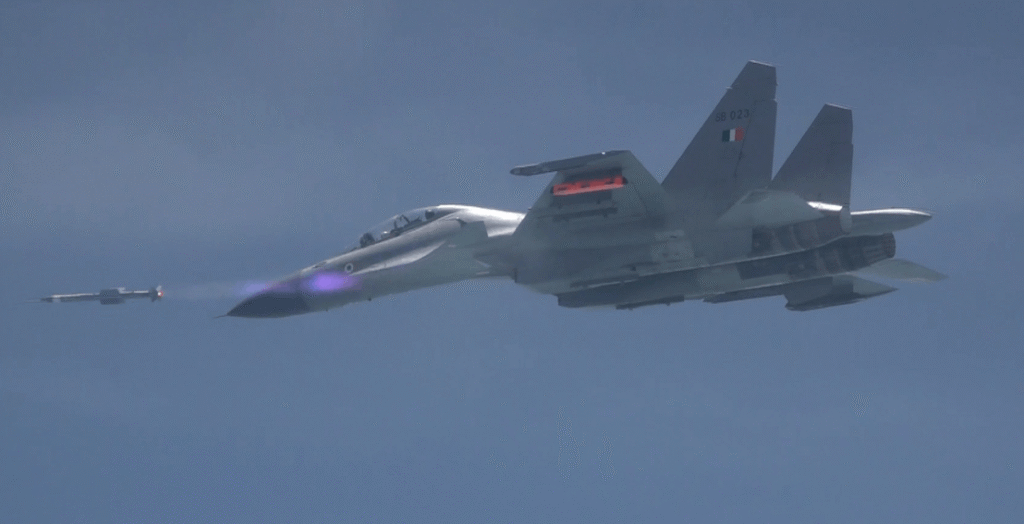
Astra Mk1’s Combat Debut: Su-30MKI’s BVR Prowess in Operation Sindoor
On the night of May 7–8, 2025, during India’s meticulously calibrated Operation Sindoor, the indigenous Astra Mk1 beyond-visual-range air-to-air missile (BVRAAM) made its combat debut — and it did not disappoint. Four Su-30MKIs of No. 15 Squadron “Flying Lances”, operating from Srinagar and Awantipora, fired six Astra Mk1s in anger against Pakistani airborne targets. All six missiles achieved direct hits. This historic first has instantly elevated the Astra family from a promising technology demonstrator to a battle-proven cornerstone of IAF’s air dominance strategy.
Operation Sindoor Context: The Night India Drew the Red Line
Following the April 26, 2025 Pahalgam terror attack that claimed 26 lives, India executed a series of precision strikes across the LoC and into Pakistan-occupied Jammu & Kashmir. While the primary mission involved stand-off weapons like BrahMos and Rampage, Pakistani Air Force F-16s and JF-17s attempted aggressive forward patrols to deter Indian aircraft. IAF responded by enforcing a 60-km deep “no-fly buffer” on the Pakistani side — a task perfectly suited for long-range BVR engagements.
Astra Mk1 Technical Breakdown: Why It Excelled
The Astra Mk1 is India’s first indigenously designed and manufactured BVRAAM, developed by DRDO’s Defence Research & Development Laboratory (DRDL) and produced by Bharat Dynamics Limited (BDL).
- Range: 110 km in head-on, 25–30 km in tail-chase
- Speed: Mach 4.5+
- Seeker: Indigenous Ku-band active radar seeker with 45° look-angle and ECCM suite
- Propulsion: Solid-fuel, single-stage, smokeless motor
- Warhead: 15 kg pre-fragmented HE with proximity fuze
- Guidance: Inertial mid-course + active radar terminal with LOAL/LOBL capability
- Weight: 154 kg – 40 kg lighter than R-77, allowing twin-rail carriage on Su-30MKI
In Operation Sindoor, all engagements were conducted beyond 75 km in head-on mode, with missiles maintaining lock even through heavy Pakistani ECM jamming. The smokeless exhaust made visual detection nearly impossible, giving PAF pilots almost no warning before impact.
Why Astra Outperformed Expectations
Multiple factors converged to produce this spectacular debut:
- Real-time mid-course updates via secure Link-Next datalink from Netra AEW&C
- Integration of Uttam AESA-derived algorithms in the seeker for superior clutter rejection
- Pre-launch “fire-and-forget” confidence validated in over 40 test firings since 2019
- Crew training on upgraded Su-30MKI simulators at Adampur using actual combat profiles
IAF sources confirm that the missile’s indigenous ECCM suite successfully defeated Chinese-origin jamming pods carried by JF-17 Block III — a capability previously unproven in combat.
Strategic Impact: A New Red Line in the Skies
The 100% success rate has fundamentally altered regional air power equations. Pakistan’s reliance on PL-15 (range ~140 km) was neutralised by Astra’s ability to engage at comparable distances with higher kinematic performance in high-altitude Himalayan conditions. For the first time, IAF achieved “first look, first shoot, first kill” dominance over the western front.
“The night of May 8 proved that Indian missiles designed in Hyderabad can outfly, outthink, and outfight anything in Pakistan’s arsenal.” – Air Chief Marshal V.R. Chaudhari, November 2025
Boost to No. 15 Squadron and Su-30MKI Fleet
No. 15 Squadron, already the first to operationally deploy BrahMos-ALCM, has now become the only unit worldwide to score BVR kills with two different indigenous missile systems. The squadron’s 18 Su-30MKIs are being prioritised for “Super-30” upgrades featuring GaN-based Uttam AESA radars and enhanced EW suites — turning them into true 5th-generation killers until AMCA arrives.
Path to Astra Mk2 and Beyond
Combat validation has fast-tracked the Astra programme:
- Astra Mk2 (160–180 km, dual-pulse motor) user trials begin January 2026
- Astra Mk3 (SFDR-powered, 300+ km) first flight scheduled 2027
- Naval variant for MiG-29K and TEDBF cleared for carrier trials 2026
- Export variant “Astra-IR” (IR seeker) already under discussion with Vietnam and Egypt
Production at BDL Nashik has been ramped up from 50 to 180 missiles per year, with a new line opening in 2026.
From Test Range to Textbook
The Astra Mk1’s flawless debut has instantly entered IAF training syllabi at Tactics and Air Combat Development Establishment (TACDE). Future pilots will now study “Sindoor Profiles” — the exact engagement geometries used on May 8 — as the new gold standard for BVR combat over mountainous terrain.
In a single night, India moved from being a cautious adopter of imported missiles to a confident wielder of world-class indigenous ones. The message to adversaries is unambiguous: India’s skies are now defended by weapons conceived, designed, and built in India.
Related Reads on DefenceNiti.com
- DRDO Unveils ‘Gaurav’ Glide Bomb for Su-30MKI – Next precision weapon on the same platform
- ET-LDHCM Hypersonic Missile Milestone – Evolution of Indian missile technology
- Indo-French Mixed Formation Flights – Where Su-30MKI crews honed advanced BVR tactics