Putin in Delhi: S-400 Deliveries Resume, Su-57 Co-Development on Table
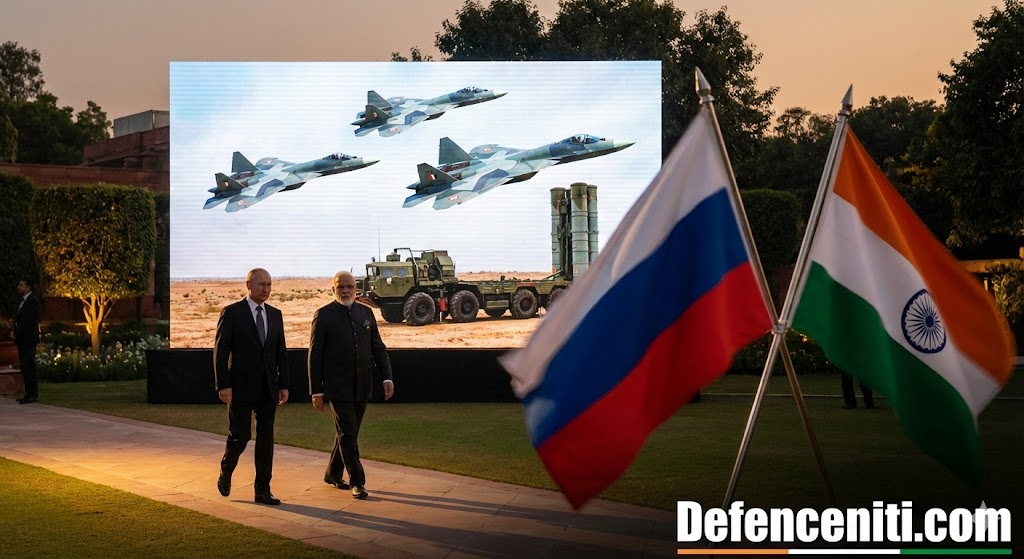
President Vladimir Putin’s lightning 18-hour visit to New Delhi on December 8–9, 2025 has delivered the most substantive outcomes in Indo-Russian defence ties in a decade. Against the backdrop of Western sanctions and a shifting global order, the two leaders signed off on a ten-year defence cooperation roadmap worth over $42 billion, headlined by:
- Immediate resumption of the two remaining S-400 Triumf regiments (delayed since 2023 due to payment and spares issues)
- Formal launch of Su-57E/FGFA-2 co-development programme with 60 % Indian content
- Joint hypersonic missile initiative (BrahMos-II/Kinzhal derivative)
- Fast-tracking of the 190 MW compact naval reactor for Project 75-Alpha SSNs
The agreements were sealed at Hyderabad House after a restricted delegation-level talk that lasted just 95 minutes — a rare format reserved for the most sensitive strategic discussions.
S-400: The Logjam Breaks
The two pending regiments (4th and 5th) were originally scheduled for delivery by mid-2024 but were held up by U.S. CAATSA threats and Russian component shortages caused by the Ukraine conflict. India has now switched entirely to rupee–rouble trade and established a dedicated spares corridor via Iran and Kazakhstan. The first batteries of the 4th regiment will reach India by March 2026, with the 5th following by October 2026. This completes India’s planned ring of five S-400 regiments covering the entire western, northern, and eastern fronts.
More importantly, Russia has agreed to co-produce the next-generation 40N6E 400-km missile and the 91N6E engagement radar in India from 2028 under a new joint venture between Almaz-Antey and Bharat Electronics Limited (BEL). This mirrors the ongoing trend of technology transfer seen at the recent SAMANVAY 2025 event. Read how DRDO is handing over cutting-edge tech to industry.
Su-57E / FGFA-2: The Stealth Fighter Returns
After India walked away from the original FGFA programme in 2018 citing insufficient stealth and technology transfer, Russia has now offered the fully matured two-seat Su-57E export variant with unprecedented concessions:
- Full transfer of source code for mission computer and avionics
- Integration of Indian AESA radar (Uttam derivative), EW suite, and Astra Mk-2/3 missiles
- Final assembly and 60 % value addition at HAL Nashik Division
- Initial batch of 114 aircraft (six squadrons) with option for 70 more
The first prototype in Indian configuration is targeted for maiden flight in 2029, with series production from 2032. The IAF sees the Su-57E as a high-end complement to the indigenous AMCA Mk-1 (expected only by 2035), providing a true fifth-generation capability a full decade earlier. This directly supports the “Year of Reforms” push for rapid capability enhancement. Why 2025 is being called the Year of Reforms.
Hypersonics & Nuclear Propulsion
Both leaders announced the formation of a Joint Hypersonic Technology Working Group to merge BrahMos-II (scramjet) and Russian 3M22 Zircon expertise, targeting a Mach 8–9 missile by 2032. Simultaneously, Rosatom and India’s BARC will accelerate the 190 MW naval reactor programme — critical for the six planned Project 75-Alpha SSNs and the future nuclear-powered aircraft carrier. These twin initiatives are cornerstone priorities of the 15-Year Defence Roadmap unveiled earlier this year. Full analysis of the ICDP 2025–2040 roadmap.
Strategic Messaging
By hosting Putin within weeks of the U.S. midterm elections and amid fresh European pressure on India over Russian oil purchases, New Delhi sent an unambiguous message: strategic autonomy remains non-negotiable. The joint statement explicitly rejected “unilateral sanctions” and called for a multipolar security architecture — language absent from recent India–U.S. 2+2 dialogues.
In conclusion, December 8, 2025 will be remembered as the day India and Russia rebooted their defence partnership for the 21st century. From S-400 batteries rolling off ships in 2026 to Indian pilots flying co-developed Su-57s by the mid-2030s, the outcomes of this visit have set the stage for India to emerge as a genuine superpower in air, land, and sea domains — with Moscow as its most reliable long-term partner.