Akula-IV Lease Renewal: INS Chakra-3 Bolsters Nuclear Sub Deterrence
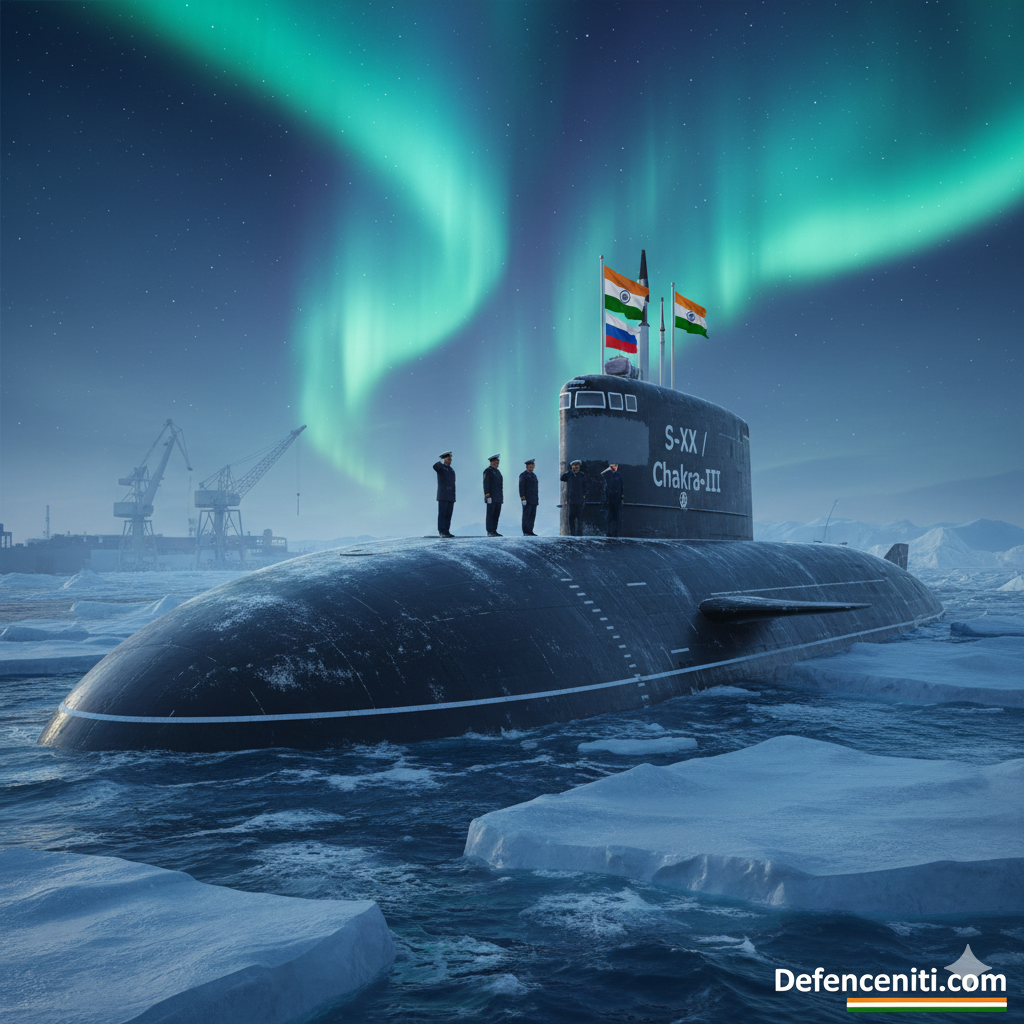
India and Russia have quietly finalised the lease of a brand-new Project 971M Akula-IV nuclear-powered attack submarine (SSN), to be commissioned as INS Chakra-III by early 2027. The $3.8-billion, ten-year lease — signed on the sidelines of President Putin’s Delhi visit last week — includes full transfer of the boat after the lease period, a first in Indo-Russian naval history. This deal not only plugs a critical decade-long gap in India’s underwater nuclear propulsion expertise but also buys precious time for the indigenous Project 75-Alpha SSN programme, now targeting first launch only in 2033–34.
The selected hull, K-322 “Kashalot” (NATO: Akula-IV), is currently completing deep modernisation at Severodvinsk’s Zvezdochka shipyard. Upgrades include:
- OK-650V reactor with 190 MWt output and 12-year refuelling cycle
- Pump-jet propulsor for < 90 dB acoustic signature — quieter than most Western SSNs
- Kalibr-PL (3M-14 land-attack) and Oniks anti-ship missile integration in eight VLS cells
- Indian communication suite, USHUS sonar, and Panchendriya unified combat management system
Delivery is scheduled for February 2027 after harbour and sea trials in the White Sea, with an all-Indian crew already undergoing 18-month training at Training Centre Obninsk and Vladivostok.
Why India Needed Chakra-III Urgently
The previous INS Chakra-II (K-152 Nerpa, Akula-II) was returned to Russia in June 2021 after a ten-year lease. Since then, the Indian Navy has operated exactly zero SSNs — a capability void that needed urgent attention.
With China expected to field 18–22 SSNs by 2035, the Navy’s 30-year Submarine Building Plan explicitly demands at least six SSNs by 2035. The Akula-IV lease gives India:
- Immediate operational experience with pump-jet, long-endurance patrols, and land-attack cruise missiles from submerged platforms
- A proven benchmark for the indigenous 6,000-tonne P-75 Alpha design
- A deterrent against Pakistani attempts to deploy Hangor-class AIP boats in the Arabian Sea
Strategic Linkages with Broader Naval Modernisation
The timing is deliberate. INS Chakra-III will arrive just as INS Vikrant completes its second operational deployment cycle and the third indigenous aircraft carrier (possibly nuclear-powered) moves into detailed design. See how Vikrant is already reshaping India’s carrier doctrine.
The SSN will routinely escort carrier groups, providing undersea air-defence and long-range strike — a role no conventional submarine can perform. It also directly supports the 15-Year Defence Roadmap’s emphasis on nuclear propulsion as a strategic enabler. Explore the nuclear propulsion pillar of ICDP 2025–2040.
Technology Transfer & Indigenisation
Unlike previous leases, Russia has agreed to:
- Transfer complete pump-jet design documentation
- Allow BARC and L&T engineers full access during refit for reactor compartment studies
- Co-develop an Indian 190 MW compact naval reactor by 2032
This mirrors the deepening trend seen in recent Indo-Russian projects. Full coverage of the 23rd Summit outcomes.
L&T’s new SSN construction yard at Katupalli (Chennai) will absorb these lessons, while the Visakhapatnam submarine-building centre prepares for simultaneous construction of three P-75 Alpha boats from 2029.
Operational Implications
Once commissioned, INS Chakra-III will be home-ported at the expanded Rambilli (Project Varsha) strategic base near Visakhapatnam, with a dedicated SSN pier capable of handling two boats by 2030. Routine patrols will cover:
- Northern Arabian Sea (countering Chinese SSNs transiting via Gwadar)
- Malacca Strait chokepoint
- Southern Indian Ocean (protecting sea lanes to Africa and Australia)
In conclusion, the Akula-IV lease is far more than a stop-gap. It is the bridge that carries India from a conventional submarine navy to a true nuclear-underwater power — a transformation explicitly mandated in the 2025 “Year of Reforms” and the long-term ICDP roadmap. When Chakra-III quietly slips out of Severodvinsk in 2027, it will carry with it the future of India’s silent service.