India-Russia Joint Venture: Il-114 Turbo-Prop Production Kicks Off in Bengaluru
Published: December 10, 2025
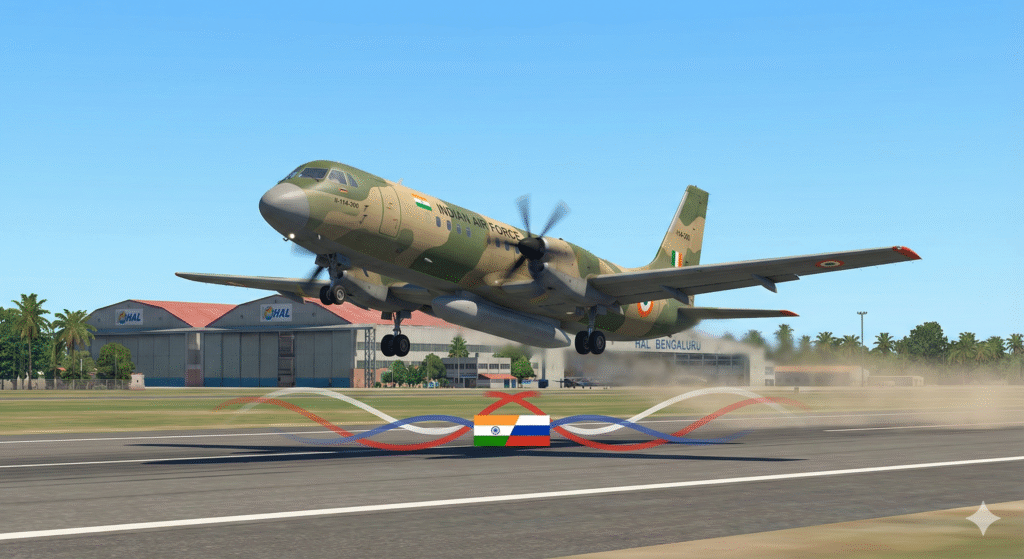
In a significant boost to India’s defense indigenization efforts, India and Russia have formally initiated the joint production of the Ilyushin Il-114-300 regional turboprop aircraft in Bengaluru. This collaboration, spearheaded by Russia’s Rostec Corporation and India’s Hindustan Aeronautics Limited (HAL), marks a new chapter in bilateral defense ties. The memorandum of understanding (MoU) was signed on October 27, 2025, in Moscow, paving the way for localized manufacturing that could include defense variants tailored for the Indian Air Force (IAF). This move aligns with India’s ‘Aatmanirbhar Bharat’ initiative, aiming to reduce dependency on foreign imports while enhancing tactical transport capabilities amid evolving geopolitical challenges.
The Il-114-300, a modernized version of the original Il-114 designed in the Soviet era, is a twin-engine turboprop aircraft capable of carrying up to 64 passengers or equivalent cargo. Developed by Russia’s United Aircraft Corporation (UAC), it features advanced avionics, fuel-efficient TV7-117ST-01 engines, and a range of over 1,900 kilometers. The aircraft is versatile, suitable for regional civilian flights, but its rugged design makes it ideal for military applications such as troop transport, medical evacuation, and surveillance in remote areas. For India, this joint venture represents an opportunity to replace aging fleets like the Antonov An-32, which have been in service with the IAF since the 1980s.
Background on the Il-114 dates back to the late 1980s when it was conceived as a successor to the An-24. Production halted in the post-Soviet era due to economic constraints, but Russia revived the program in the 2010s with the Il-114-300 variant. The first flight of the modernized prototype occurred in 2020, and certification was completed by 2023. Russia’s push for international partnerships stems from sanctions imposed after the Ukraine conflict, which disrupted supply chains for Western components. By partnering with India, Russia gains access to a stable manufacturing base and a large market, while India benefits from technology transfer and cost-effective production.
The joint venture’s kickoff in Bengaluru leverages HAL’s extensive facilities, including its Aircraft Division, which has experience in producing aircraft like the Dornier 228 and the indigenous Light Utility Helicopter (LUH). Initial talks began earlier in 2025, as revealed by Rostec chief Sergey Chemezov during bilateral discussions. The MoU outlines a phased approach: Phase 1 involves assembly of knocked-down kits imported from Russia, transitioning to full indigenous production by Phase 3. HAL will integrate local subsystems, such as avionics from Bharat Electronics Limited (BEL) and composites from private players like Tata Advanced Systems. This collaboration is expected to create over 1,500 jobs in Karnataka and foster a ecosystem for aerospace components.
For the IAF, the defense variants of the Il-114 could address critical gaps in medium-lift transport. Equipped with ramps for quick loading, the aircraft can operate from short, unprepared airstrips—vital for operations in the Himalayas and island territories. This ties directly into recent infrastructure developments, such as the activation of the Nyoma Airbase in eastern Ladakh, which enhances high-altitude capabilities near the Line of Actual Control (LAC). Read more about the Nyoma Airbase activation here, which complements such tactical assets.
Moreover, this venture strengthens Indo-Russian defense cooperation amid global turbulence. The 23rd India-Russia Summit in December 2025 focused on joint projects, including technology transfers. Explore how Indo-Russian ties are elevating amid global challenges. This Il-114 project builds on existing collaborations like the BrahMos missile and Su-30MKI fighters, potentially extending to customized variants similar to France’s proposal for a tailored Rafale in the Multi-Role Fighter Aircraft (MRFA) tender. Learn about the tailored MRFA for IAF’s needs, which highlights the trend toward co-developed platforms.
Training and simulation will be key to integrating the Il-114 into IAF operations. Adani Defence’s recent acquisition of a flight simulation firm for ₹820 crore could play a role in developing simulators for this aircraft. Discover Adani’s stake in flight simulation, which aims to advance pilot training through indigenous tech. This aligns with the Defence Minister’s declaration of 2025 as the ‘Year of Reforms’ for the Armed Forces, emphasizing modernization and efficiency. Delve into 2025 as the Year of Reforms.
Under the Defence Research and Development Organisation’s (DRDO) SAMANVAY 2025 initiative, technology transfers like those in the Il-114 project fuel the private defense boom. See how DRDO’s SAMANVAY is boosting private involvement. The 15-Year Defence Roadmap (ICDP 2025–2040) prioritizes AI, hypersonics, and such indigenous productions to transform India’s defense posture. Review the 15-Year Defence Roadmap for insights into future priorities.
Challenges remain, including compliance with US sanctions under CAATSA, which previously affected S-400 deliveries. However, India’s strategic autonomy allows navigation of these hurdles. Supply chain diversification is crucial, especially with global disruptions. The project could face delays in certification for defense variants, but Russia’s experience and India’s growing aerospace sector mitigate risks.
Economically, the venture is projected to save India billions in imports while exporting to Southeast Asia and Africa. It supports the ‘Make in India’ campaign, with over 60% local content targeted by 2030. Experts like Air Marshal (Retd.) Anil Chopra note that this could accelerate India’s path to becoming an aerospace hub.
In conclusion, the Il-114 joint venture in Bengaluru is more than a production deal—it’s a strategic pivot toward self-reliance in defense aviation. As India bolsters its tactical transport amid border tensions and regional dynamics, this collaboration with Russia reinforces longstanding partnerships. With interlinked reforms and tech transfers, the future looks promising for India’s defense ecosystem.