
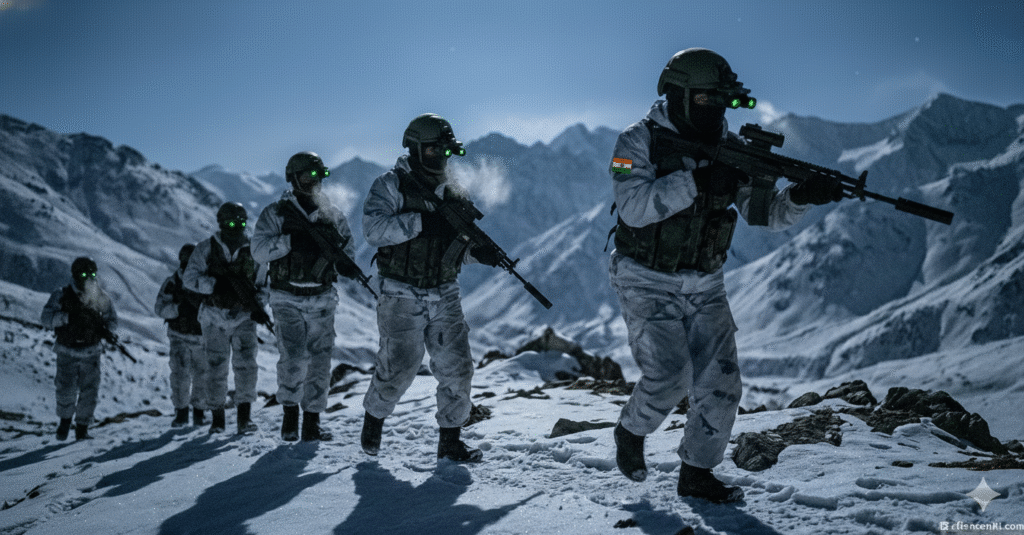
Bhairav Commandos & Ashni Drones: Army’s New Border Deterrence Arsenal
Bhairav Battalions: Lean, Lethal Strike Forces
Unveiled by Chief of Army Staff General Upendra Dwivedi on July 26, 2025, during Kargil Vijay Diwas commemorations in Ladakh, the Bhairav battalions bridge the operational gap between conventional infantry (800+ personnel) and Para-Special Forces (strategic deep strikes). Each unit comprises 250 specially selected soldiers—volunteers from infantry regiments, augmented by 5 from Air Defence, 4 from Artillery, and 2 from Signals—trained for 2-3 months at regimental centers followed by Para-SF attachments.
Key capabilities include:
- Night Operations & Stealth Infiltration: Equipped with NVG helmets, suppressed carbines (e.g., 4.25 lakh new close-quarter battle weapons), and advanced camouflage for zero-signature raids in Himalayan fog or desert nights.
- Anti-Infiltration & Quick Raids: Optimized for disrupting enemy supply lines, sabotage, and heliborne insertions; each battalion carries indigenous loitering munitions like Nagastra-1 for precision strikes.
- Multi-Domain Integration: Embedded artillery spotters and signals teams enable real-time fire support from Pinaka systems or drone overwatch, taskable at Corps level for rapid response.
The initial five battalions went operational on October 1, 2025, with full readiness by month’s end: one each in Leh (LAC), Srinagar (LoC), Nagrota (J&K), Western Desert (Rajasthan), and Northeast (Eastern Command). By mid-2026, 25 such units will cover all frontiers, relieving Para-SF for high-value missions while augmenting Rudra all-arms brigades.
Ashni Drones: Persistent Eyes and Lethal Wings
Complementing the human element, the Ashni platoons—each with 20-25 drone operators—democratize UAV warfare, rolling out to 385 infantry battalions by October 2025. Funded under a Rs 19.81 billion tranche from the 2025-26 defence budget, these units debuted in Exercise Yudh Kaushal 3.0 (Arunachal Pradesh, September 2025), showcasing swarm tactics that overwhelmed simulated Chinese positions.
Each platoon fields 10 drones:
- Surveillance/Reconnaissance (4 units): Long-endurance UAVs like Black Hornet nano-drones and Switch UAVs for real-time ISR up to 10 km, integrated with Project Sanjay battlefield management for 360° feeds to command posts.
- Loitering Munitions (6 kamikaze units): Nagastra-1 and imported Switchblade variants for autonomous strikes; 5-15 km range, 30-minute loiter, warheads tunable for personnel or light armor.
With over 3,000 drones Army-wide (7,600+ operatives), Ashni enables “eagle on the arm” ops: a soldier’s thermal sight cues a swarm, delivering precision fire within minutes. Low-level radars and VSHORADS (QRSAM) protect against counter-drone threats, while AI algorithms from DRDO’s IITM Pravartak predict enemy movements.
Post-Sindoor Restructuring: Lessons in Hybrid Warfare
Operation Sindoor exposed gaps in real-time intel and rapid escalation—Pakistani drones provided edge in initial skirmishes, neutralized only by S-400 intercepts. The Bhairav-Ashni duo addresses this: Bhairavs conduct heliborne disruptions (e.g., targeting PLA patrols in Depsang), while Ashnis maintain persistent surveillance along the 3,488 km LAC and 740 km LoC.
Deployment hotspots:
| Region | Bhairav Role | Ashni Support |
|---|---|---|
| LAC (Eastern Ladakh) | High-altitude raids on supply routes | Swarm overwatch for Galwan-like patrols |
| LoC (J&K) | Anti-infiltration ambushes | Border fence monitoring & kamikaze intercepts |
| Western Desert | Deep strikes on mechanized threats | Recon for tank hunter-killer teams |
| Northeast | Unconventional ops in terrain | ISR for Myanmar border ops |
This hybrid model aligns with the Army’s 380-battalion rollout, embedding tech in every rifle company for “disaggregated” warfare—small teams striking independently, fused via digital networks.
Training and Tech Backbone
Bhairav recruits undergo “son of the soil” selection—local regiments provide terrain experts—followed by Para-SF drills in sabotage, CQB, and drone cueing. Ashni operators, often Agniveers, train on containerized ranges with VR simulations, achieving 90% mission success in Thar Shakti 2025 exercises.
Indigenous edge: 80% of Ashni drones (Nagastra, Black Hornet licensed) and Bhairav gear (Divyastra munitions) ensure self-reliance, with Rs 6.2 lakh crore budget sustaining 100,000+ new weapons annually.
“Bhairav brings the ferocity, Ashni the fire—together, they ensure no inch of our border is blind or undefended.” — Lt Gen Ajay Kumar, DG Infantry, October 2025
Strategic Horizon: Two-Front Deterrence
By 2027, 25 Bhairav battalions and full Ashni saturation will equip the Army for simultaneous LAC-LoC threats, countering PLA’s drone swarms and Pak’s tunnel incursions. Analysts predict 40% faster response times, reducing escalation risks in hybrid gray-zone ops.
As borders simmer, Bhairav and Ashni aren’t just units—they’re the Army’s new vanguard, blending human grit with silicon smarts for a sovereign shield.
Related Reads on DefenceNiti.com
- Indian Army Trials Oerlikon Skyshield – Air defence synergies for drone ops
- President Murmu Inaugurates Chanakya Defence Dialogue – Strategic border insights
- DRDO Unveils ‘Gaurav’ Glide Bomb – Precision munitions for commando strikes