
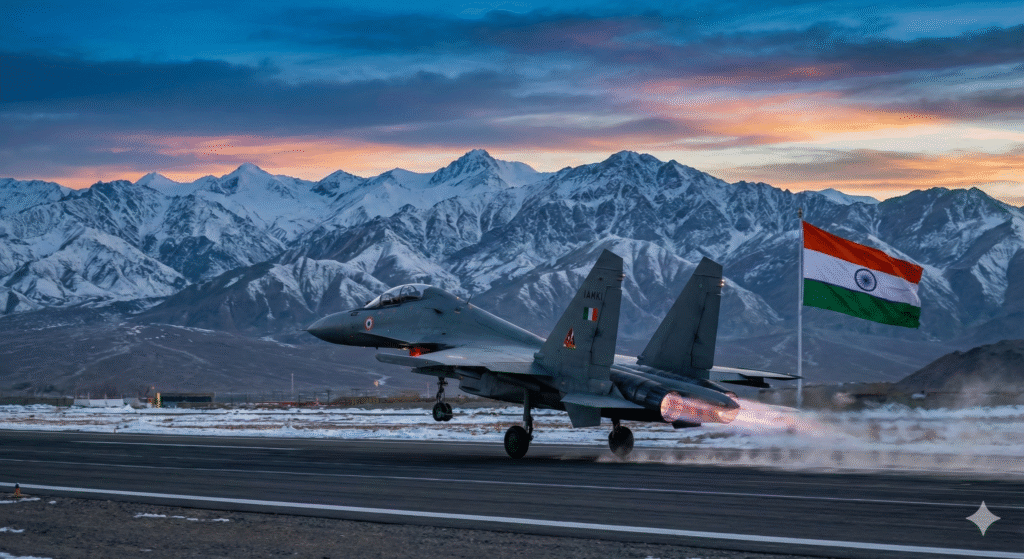
Nyoma Airbase Activation: India’s High-Altitude Edge Against China in Ladakh
In a quiet but seismic development along the Line of Actual Control (LAC), the Indian Air Force formally operationalised the Nyoma Advanced Landing Ground (ALG) in eastern Ladakh on November 22, 2025. Located just 46 km from the LAC and at a staggering altitude of 13,700 feet (4,180 metres), Nyoma is now the world’s highest fighter-capable airbase. The activation ceremony – led by Air Marshal A.K. Bharti, AOC-in-C Western Air Command – marked the culmination of a decade-long project that transforms India’s high-altitude air power posture against China.
From Dirt Strip to Strategic Fortress
Originally constructed in 1962 as a rudimentary emergency strip, Nyoma remained dormant for decades. Post the 2020 Galwan crisis, the Ministry of Defence fast-tracked its revival under the “Vibrant Villages” and border infrastructure push. What began as a 3-km compacted soil runway in 2009 has now evolved into a full-fledged 4.2-km asphalt runway capable of handling C-17 Globemaster III heavy-lift aircraft, C-130J Super Hercules, and all IAF fighter types including Su-30MKI, Rafale, and Tejas.
Key infrastructure now includes:
- 4.2 km × 45 m runway with RESA (Runway End Safety Area) compliant to ICAO standards
- Parallel taxi track and two large aprons for 12+ fighters
- Hardened Aircraft Shelters (HAS) for 18 aircraft
- Underground fuel storage (2.4 million litres capacity)
- Modern ATC tower with DVOR/DME and ILS Cat-II
- Integrated mountain warfare complex for 1,200 personnel
The base is designed to operate at -40°C and oxygen levels 40% lower than sea level – conditions that previously restricted sustained fighter operations above 12,000 feet.
Cutting Response Time by Half
Prior to Nyoma’s activation, the nearest permanent fighter base was Leh (110 km away), and the closest all-weather fighter base was Adampur in Punjab (over 600 km). In a crisis, it took IAF 45–60 minutes to scramble Su-30MKIs from the plains to eastern Ladakh. Nyoma slashes this to under 12 minutes for fighters already on ORP (Operational Readiness Platform) and under 25 minutes even for cold starts from Punjab bases using aerial refuelling.
“Nyoma gives us the ability to generate 60–80 sorties per day from Ladakh itself instead of 20–25 from distant bases. It is a force multiplier of the highest order.” – Air Marshal A.K. Bharti, November 22, 2025
Strategic Location: Watching the Entire Eastern Sector
Situated in the Indus valley, Nyoma dominates three critical axes:
- Chushul-Demchok corridor – site of the 2020 standoff
- Fukche-Dungti axis – PLA’s primary supply route to Moldo garrison
- Depsang Plains approach – where Chinese troops blocked Indian patrols in 2024–25
Within 200 km radius lie Chinese airbases at Hotan, Ngari Gunsa, and Kashgar – all now within unrefuelled combat radius of IAF fighters operating from Nyoma. The base also provides direct line-of-sight for Akashteer air defence network and the newly deployed S-400 squadron at Leh, creating a layered A2/AD bubble over southern Ladakh.
Integration with New-Generation Systems
Nyoma is not a standalone outpost – it is the nerve centre of a networked high-altitude warfare ecosystem:
- S-400 Triumph at Leh (120 km) and upcoming regiment at Nyoma itself (2026)
- Akash-NG & QRSAM batteries along the Darbuk–Shyok–DBO road
- Net-centric linkage with Himalayan IACCS nodes
- High-altitude drone corridor for Heron Mk-II and TAPAS BH-201 MALE UAVs
The base hosted its first night combat exercise on November 26, 2025, when two Su-30MKIs armed with BrahMos-ALCM and Astra Mk2 missiles conducted live weapon release at the nearby Mahabodhi range – demonstrating full-spectrum capability at extreme altitude.
Comparison with Chinese Airbases Across the LAC
China operates seven high-altitude airbases within 400 km of Ladakh, but Nyoma now neutralises several advantages:
| Parameter | Nyoma (India) | Ngari Gunsa (China) | Hotan (China) |
|---|---|---|---|
| Altitude | 13,700 ft | 14,022 ft | 4,700 ft |
| Runway Length | 4.2 km | 4.5 km | 3.2 km |
| Fighter Types | Su-30, Rafale, Tejas | J-11, J-20 (limited) | J-20, J-16 |
| Distance from LAC | 46 km | 210 km | 380 km |
| Heavy-lift Capable | Yes (C-17) | No | Yes |
Nyoma’s lower operating altitude than Ngari Gunsa actually gives IAF fighters better thrust-to-weight performance, while its proximity to the LAC provides decisive time advantage.
Broader Border Infrastructure Synergy
Nyoma forms the aerial crown of a massive border build-out since 2020:
- Darbuk–Shyok–Daulat Beg Oldi road (255 km all-weather axis)
- 15 new ALGs in Arunachal and Ladakh
- Sub-sector North logistics hub at Partapur (operational 2025)
- World’s highest tunnel at Shinku La (16,000 ft, opening 2026)
Together, these assets reduce India’s mobilisation timeline from weeks to hours – a capability gap that forced caution during the 2020–22 standoff.
The Road Ahead: Phase-II Expansion
Phase-II (2026–28) will see:
- Extension to 4.5 km runway for sustained AWACS operations
- Deployment of second S-400 regiment
- Permanent basing of one Rafale squadron (No. 17 Golden Arrows)
- Integration with Project Kusha directed-energy weapons
By 2030, Nyoma is planned to evolve into a full-fledged “Air Dominance Base” with underground hangars and hypersonic weapon storage.
A Quiet but Definitive Shift
Unlike the fanfare of INS Vikrant commissioning, Nyoma’s activation was deliberately low-key – reflecting India’s maturing strategic culture. Yet its impact is profound. For the first time since 1962, India possesses the ability to dominate the air over eastern Ladakh on demand – a capability that alters the calculus of any future border crisis.
As one senior IAF officer remarked anonymously: “In 2020 we reacted. In 2025, we dictate.”
Nyoma is not just an airbase. It is the physical manifestation of India’s resolve to never again be surprised on its northern frontiers.


Pingback: India-Russia Joint Venture - DefenceNiti.com