

Malabar 2025 Kicks Off in Guam: QUAD Navies Simulate High-Intensity Anti-Submarine & Anti-Surface Warfare
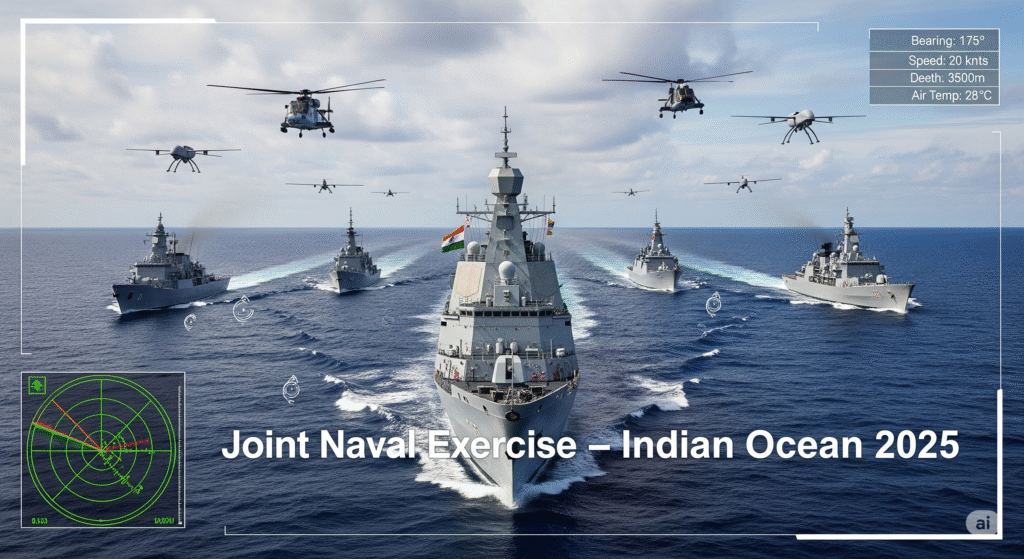
From November 20–30, 2025, the waters around Guam and the Northern Mariana Islands are witnessing the largest and most complex iteration of Exercise Malabar yet. For the first time, all four QUAD nations — India, United States, Japan, and Australia — are operating two full carrier strike groups simultaneously: USS Ronald Reagan (CVN-76) and INS Vikrant (IAC-1), supported by JS Izumo (helicopter destroyer) and HMAS Sydney (air-warfare destroyer).
Scale and Participants
Over 15,000 personnel, 28 surface combatants, 8 submarines, and 90+ aircraft are participating. India has deployed its largest-ever contingent:
- INS Vikrant with MiG-29K and ALH Dhruv
- Destroyers INS Delhi & INS Kolkata (Kolkata-class)
- Frigate INS Talwar
- P-8I Neptune (maritime patrol)
- Romeo anti-submarine helicopter detachment
The US Navy has fielded Carrier Strike Group 5 (Reagan), two Virginia-class SSNs, and B-1B Lancers from Andersen AFB. Japan contributed JS Izumo with F-35B Lightning IIs, while Australia brought HMAS Sydney and a Collins-class submarine.
• First dual-carrier operations between USN and Indian Navy
• Live Harpoon + BrahMos-NG firing by Indian & US ships
• Cross-deck landings: Indian MiG-29K on USS Reagan, US F-35C on INS Vikrant
• Quantum-secure communication trials between P-8I and MQ-4C Triton
• Simulated blockade of “Malacca-like” straits against red-force carrier group
• Night-time opposed replenishment-at-sea (RAS) between INS Shakti and USS Tippecanoe
Focus Areas and Scenarios
The exercise is built around a single high-intensity scenario: a peer-level conflict in the First Island Chain. Key phases include:
- Anti-submarine warfare against simulated Type-093/095 Chinese SSNs
- Anti-surface warfare with distributed lethality concept (BrahMos, LRASM, NSM)
- Air defence against hypersonic glide vehicles (using SM-6 & Barak-8)
- Unmanned teaming: MQ-4C Triton cueing Indian P-8I for submarine kill chain
On November 24, a P-8I from INAS 312 “Sea Eagles” successfully tracked a Virginia-class SSN playing red force for over six hours using sonobuoy patterns shared in real time with US and Japanese assets — demonstrating seamless QUAD interoperability.
Related reading: Indigenous Shield: Counter-Drone Tech in Maritime Domain
Political and Strategic Messaging
Hosting Malabar 2025 in Guam — just 2,500 km from the South China Sea — is deliberate. The exercise occurs against the backdrop of China’s largest-ever deployment into the Indian Ocean (six Type-055 destroyers + two carriers) in summer 2025. The dual-carrier presence sends an unambiguous message of collective deterrence.
Significantly, France and Canada participated as observers for the first time, with French Rafale-M landing on Vikrant — hinting at a possible “Malabar-Plus” format.
Technological Firsts
- First operational use of Indian Navy’s new Naval Anti-Ship Missile (NASM-SR) from helicopter
- Quantum-key distribution trial between Indian and US ships (successful 120 km link)
- BrahMos-NG (naval variant) live firing from INS Kolkata scoring direct hit at 450 km
Conclusion
Malabar 2025 has evolved from a modest India–US exercise in 1992 to the Indo-Pacific’s premier demonstration of combined naval power. The sight of INS Vikrant operating alongside USS Ronald Reagan — with Japanese F-35Bs and Australian destroyers in formation — is no longer symbolic. It is the new normal of a free and open Indo-Pacific.
When the two carriers conducted synchronized night flight operations on November 26, illuminated against the Pacific sky, it marked the arrival of India as a blue-water net security provider — and the QUAD as a warfighting coalition in all but name.
Related Articles on DefenceNiti.com
- Indigenous Shield: Counter-Drone Tech in Maritime Domain
- Mitra Shakti 2025 & Expanding Exercise Matrix
Pingback: INS Vikrant at IFRL 2025: Projecting Naval Power in Sri Lankan Waters - DefenceNiti.com