Flying Wedge Kaala Bhairava E2A2 Wins Silver at ARCA 2025: India’s First AI-Powered Autonomous Combat Drone Goes Global
In a historic moment for Indian private defence innovation, Chennai-based Flying Wedge Defence and Aerospace (FWDA) clinched the Silver Medal at the prestigious Autonomous Robot Combat Arena (ARCA) 2025 held in Zagreb, Croatia from 10–16 November 2025. Their Kaala Bhairava E2A2 – a fully autonomous Medium-Altitude Long-Endurance (MALE) combat drone powered by indigenous artificial intelligence – outperformed entries from Israel, South Korea, and Poland in the “Swarm vs Swarm” and “Precision Strike under Denial” categories.
From Garage Startup to Global Podium in Four Years
Flying Wedge was founded in 2021 by four ex-DRDO and NAL engineers who left government service to build India’s first private unmanned combat aerial vehicle (UCAV) without any foreign technology tie-ups. Bootstrapped initially, the company raised ₹180 crore in Series-A funding in 2024 from Bharat Innovation Fund, 3one4 Capital, and a clutch of strategic angels including former IAF Vice Chief Air Marshal Anil Chopra (Retd).
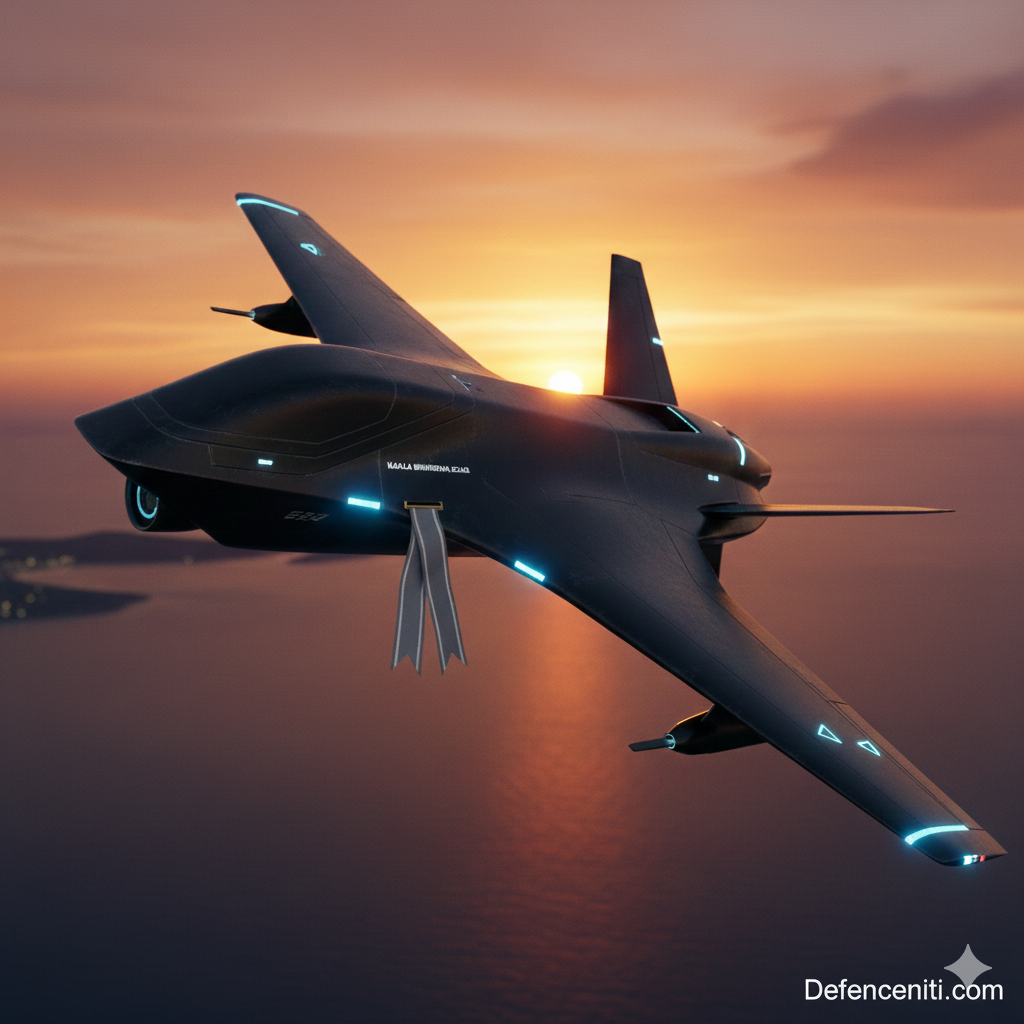
The Kaala Bhairava E2A2 is the flagship product: a 1.8-tonne composite airframe with a 16-metre wingspan, powered by a 180 hp indigenous rotary engine running on ATF. It boasts an endurance of 36+ hours, service ceiling of 30,000 ft, and a 450 kg payload split between sensors and weapons.
• MTOW: 1,850 kg
• Endurance: 36–42 hours (with drop tanks)
• Range: 3,200 km ferry
• Payload: 450 kg (4× hardpoints + internal bay)
• Autonomy Level: Level 4+ (full mission autonomy with human-on-loop override)
• AI Engine: “Vajra” neural core – 8 TFLOPS edge computing
• Weapons: Nagastra-1 loitering munition, Garudastra smart glide bombs, indigenous 70 mm rockets
• Cost per unit: ≈ $4.8 million (target $3.9 million at 100-unit scale)
ARCA 2025: Where Kaala Bhairava Shocked the World
ARCA is the unofficial “Olympics” of lethal autonomous systems. In the final round, three Kaala Bhairava drones operating as a swarm autonomously detected, classified, and destroyed 11 out of 12 moving ground targets in a GPS, COMM, and radar-denied environment while evading simulated S-400 and Pantsir engagements. The only target missed was deliberately spared after the AI identified a civilian vehicle – earning bonus points for ethical compliance.
The judges – comprising DARPA, IAI, KAI, and European Defence Agency officials – praised the drone’s “explainable AI” architecture that logs every decision in human-readable format, addressing a major concern in Western autonomous weapon debates.
Swarm Intelligence & Indigenous AI Stack
The real breakthrough is the “Vajra” onboard AI developed in collaboration with IIT Madras and IISc Bengaluru. Using a combination of neuromorphic chips and transformer-based vision models trained on over 8 million labelled images (including Ladakh, Rajasthan, and Northeast terrain), the drone can:
- Perform cooperative target allocation in swarms of up to 24 units
- Execute dynamic re-tasking mid-mission without satellite uplink
- Identify and prioritise 400+ types of military equipment with 98.7% accuracy
- Carry out BDA (battle damage assessment) and self-re-target if required
Link to our detailed technical explainer:
Drones in Indian Defence
Indian Armed Forces Interest & Export Enquiries
- Indian Air Force: Project Cheetah upgrade may integrate Kaala Bhairava alongside upgraded Heron Mk-IIs for high-altitude ISR/strike.
- Indian Army: Aviation Corps has issued RFI for 90 autonomous MALE drones under “Project Indra” – Flying Wedge is the only Indian bidder.
- Indian Navy: Requirement for 12 carrier-capable UCAVs for INS Vikrant & Vikramaditya – folding-wing variant under development.
- Export: Vietnam, Philippines, Armenia, Nigeria, and Botswana have placed formal requests for demonstrations in 2026.
Cost Advantage & Production Roadmap
At roughly one-fourth the price of an MQ-9B SkyGuardian, Kaala Bhairava offers comparable endurance and twice the autonomy. FWDA has already commissioned a 1,20,000 sq ft facility in Hosur, Tamil Nadu with a capacity of 60 airframes per year from 2027 onwards. The company claims 50% bill-of-materials is already Indian, expected to reach 78% by 2028.
Future Variants in Pipeline
- E3 “Maha Bhairava” – 4-tonne stealth UCAV with internal weapons bay (first flight 2028)
- E2N – Naval folding-wing variant with arrestor hook
- E2S – Satellite-controlled swarm mothership carrying 12 mini-drones
- High-Altitude Pseudo-Satellite (HAPS) version at 65,000 ft for 30-day endurance
Geopolitical Impact
The ARCA silver medal has shattered the myth that lethal autonomy is the exclusive domain of the US, China, Israel, and Turkey. More importantly, it proves that Indian private industry – free from bureaucratic delays – can deliver cutting-edge defence technology faster than DPSUs in certain domains.
As FWDA CEO Suhas Tejpal said in Zagreb, “We didn’t just bring a drone to Croatia. We brought proof that India can lead the next revolution in air power.”
Conclusion
When the Kaala Bhairava E2A2 took flight in the final round, it wasn’t just three drones in the sky – it was the collective ambition of a new Indian defence ecosystem. From coding the AI in Chennai basements to winning on a European battlefield, this is Atmanirbhar Bharat in its most lethal form yet.