LCA Tejas Shines at Dubai Air Show 2025: A Milestone for India’s Indigenous Aviation
In the bustling skies over Al Maktoum International Airport, where the hum of jet engines mingles with the chatter of global defence dealmakers, India’s Light Combat Aircraft (LCA) Tejas has emerged as an undisputed star. The Dubai Air Show 2025, unfolding from November 17 to 21, has provided the perfect stage for this homegrown marvel to showcase its prowess. With dynamic flight demonstrations that left spectators in awe, the Tejas not only highlighted its advanced manoeuvrability and multi-role capabilities but also signalled a pivotal moment in India’s journey towards self-reliance in military aviation. As delegations from over 100 international air forces gathered, the event underscored New Delhi’s bold ambitions to penetrate export markets, amid escalating geopolitical tensions in the Indo-Pacific region.
The Tejas Legacy: From Humble Beginnings to Global Contender
The story of the LCA Tejas is one of perseverance and innovation. Initiated in the 1980s under the Light Combat Aircraft programme by the Aeronautical Development Agency (ADA) and Hindustan Aeronautics Limited (HAL), the Tejas was conceived to replace the ageing MiG-21 fleet of the Indian Air Force (IAF). After decades of developmental hurdles—including delays in engine integration and avionics—the aircraft achieved Initial Operational Clearance (IOC) in 2011 and Final Operational Clearance (FOC) in 2019. Today, the Tejas Mk-1A variant, with its upgraded GE F404-IN20 engines, active electronically scanned array (AESA) radar, and electronic warfare suite, stands as a testament to India’s engineering grit.
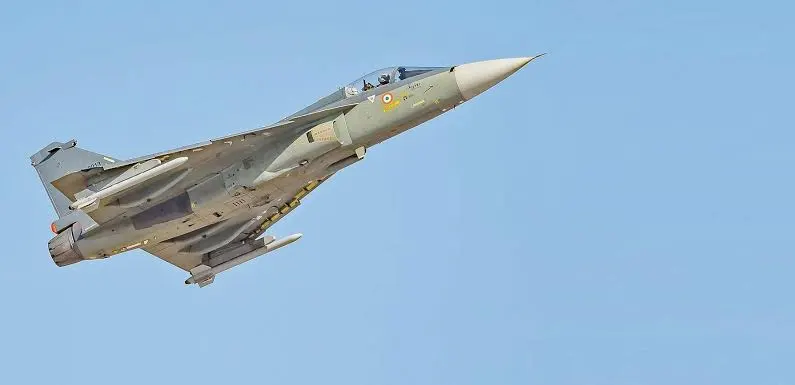
At the Dubai Air Show, the Tejas Mk-1A performed a series of high-G manoeuvres, including tight loops and supersonic passes, demonstrating its fly-by-wire controls and relaxed stability design. Pilots from the IAF’s No. 45 Squadron, the “Flying Daggers,” executed these with precision, drawing applause from UAE officials and potential buyers from Southeast Asia and the Middle East. The aircraft’s lightweight composite airframe—comprising 45% composites—allows for a thrust-to-weight ratio exceeding 1:1, enabling it to outpace many fourth-generation fighters in agility. Equipped with the Uttam AESA radar, capable of tracking 64 targets simultaneously, and armed with Astra beyond-visual-range missiles, the Tejas is primed for air-to-air and air-to-ground missions alike.
Strategic Implications for India’s Defence Exports
India’s defence exports have surged from a modest $200 million in 2014 to over $2.5 billion in FY 2024-25, driven by the ‘Make in India’ and Atmanirbhar Bharat initiatives. The Tejas represents the crown jewel in this export push. While the IAF has committed to 83 Mk-1A jets in a $6.8 billion deal with HAL, eyes are now on foreign sales. The UAE, host to the air show, has expressed interest in acquiring 18-36 units to bolster its fleet alongside French Rafales. Similarly, nations like Argentina, which shelved a MiG-35 deal due to sanctions, view the Tejas as a cost-effective alternative at around $40-50 million per unit—half the price of an F-16.
This export potential is not just economic; it’s strategic. As China expands its influence through the Belt and Road Initiative, India counters with defence diplomacy. The Tejas aligns with the QUAD’s vision of a free and open Indo-Pacific, offering partners an affordable, interoperable platform free from Western export restrictions. HAL’s pavilion at the show featured scale models and simulators, attracting inquiries from the Philippines and Malaysia, both navigating South China Sea disputes. For interlinking with our ongoing coverage on India’s Defence Export Strategies, this event exemplifies how indigenous platforms like Tejas can diversify supply chains and reduce dependency on Russian hardware, a theme echoed in our analysis of post-Ukraine war shifts.
Technological Edge and Future Upgrades
What sets the Tejas apart is its indigenous ecosystem. Over 65% of its components are ‘Made in India,’ including the Kavach electronic warfare system and the Derby missile integration. At Dubai, HAL unveiled concept art for the Tejas Mk-2, a 4.5-generation upgrade with a 25% larger airframe, GE F414 engines delivering 98 kN thrust, and stealth features like serpentine inlets. Slated for first flight in 2027, the Mk-2 could incorporate AI-driven mission computers and hypersonic weapon compatibility, positioning India in the fifth-generation race alongside the Advanced Medium Combat Aircraft (AMCA).
Behind the scenes, DRDO’s contributions shone through. The air show’s static display included Tejas variants integrated with the Akash-NG surface-to-air missile, showcasing network-centric warfare capabilities. Experts at the event noted the aircraft’s low radar cross-section (RCS) of 0.5 square meters, enhanced by radar-absorbent materials—a leap from earlier prototypes. For readers interested in deeper tech dives, explore our related piece on AMCA Engine Development, which discusses parallel advancements in powerplants that could trickle down to Tejas upgrades, ensuring long-term sustainability.
Challenges and the Road Ahead
Despite the glamour, challenges persist. The IAF’s squadron strength hovers at 31 against a sanctioned 42, with Tejas deliveries lagging due to supply chain issues with GE engines. Critics argue that export ambitions risk domestic shortfalls, a concern voiced in parliamentary committees. Moreover, competing with established players like Saab’s Gripen or South Korea’s FA-50 requires aggressive marketing and offset packages—HAL’s offer of 50% offsets, including local MRO facilities, is a step forward.
Geopolitically, the timing is impeccable. With Russia’s Sukhoi deliveries delayed by the Ukraine conflict, India pivots westward. The Dubai show coincides with the India-UAE CEPA review, potentially unlocking co-production deals. As one IAF officer quipped during a post-demo briefing, “Tejas isn’t just flying high; it’s rewriting the rules of engagement.”
Global Echoes and India’s Aerospace Ascendancy
The Tejas’s performance has rippled across global media. Aviation Week dubbed it “India’s Export Enigma,” while Jane’s Defence Weekly highlighted its role in countering Pakistan’s JF-17 Thunder. For the UAE, integrating Tejas could diversify from Dassault dependencies, fostering trilateral ties with Israel via BrahMos missile tech.
Looking beyond 2025, the Tejas programme eyes unmanned variants and carrier-based operations for the INS Vikrant. This evolution ties into broader narratives on Indian Navy’s Naval Aviation Strategies, where Tejas-N could bridge gaps in deck-based fighters. As HAL ramps up production to 24 jets annually by 2028, the Dubai spotlight illuminates a brighter horizon for India’s $75 billion defence industry.
In conclusion, the LCA Tejas at Dubai Air Show 2025 is more than a display—it’s a declaration. India, once a mere importer, is now an innovator and exporter, fortifying alliances and securing skies. As the curtains close on the event, the Tejas soars on, embodying the spirit of Aatmanirbhar Bharat in every loop and roll.
Related Articles on DefenceNiti.com
- AMCA Engine Development: Powering India’s 5th Gen Fighter – Explore synergies with Tejas upgrades.