
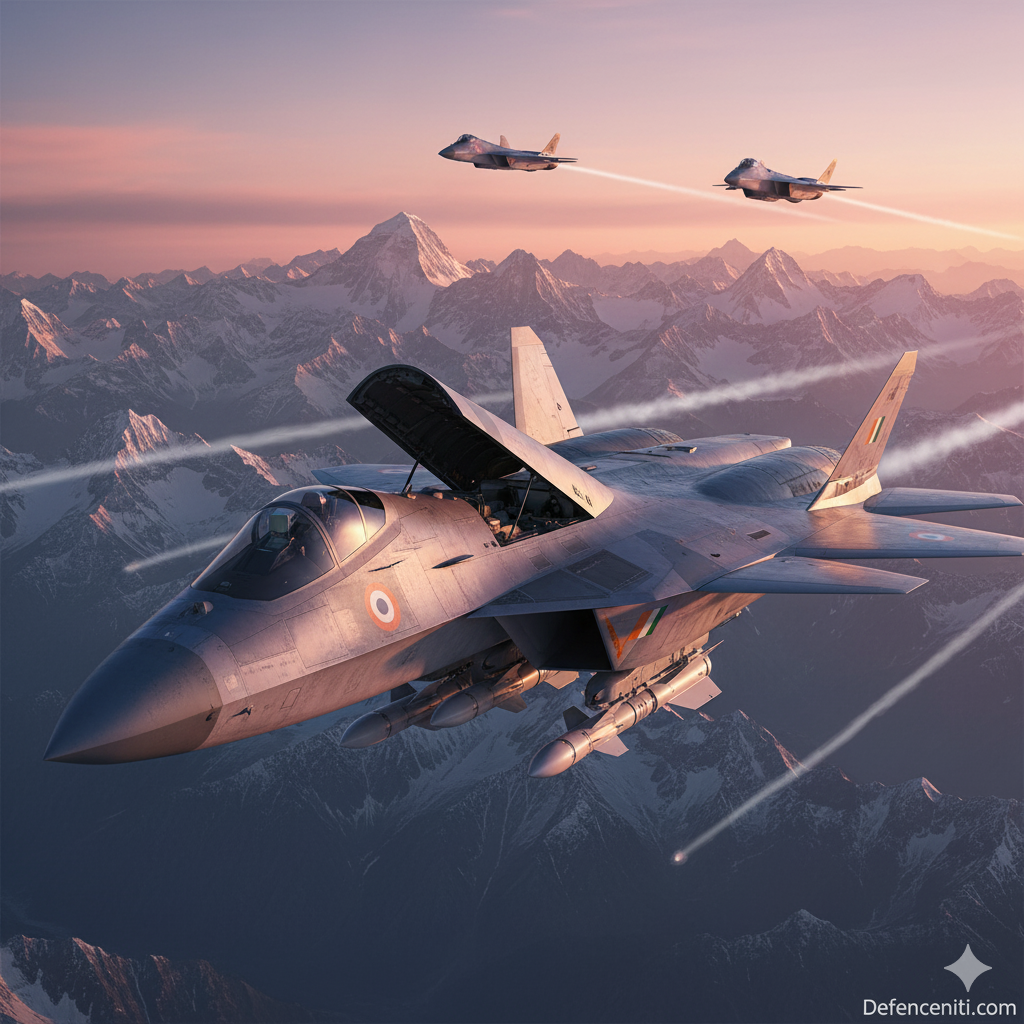
Astra’s Extended Reach: 250-km Variant and Su-57 Offers Signal IAF’s Next-Gen Air Superiority Push
As the Indian Air Force races to rebuild squadron strength to 42 by 2035, two parallel developments this month have dramatically sharpened its beyond-visual-range combat capability: DRDO’s successful captive-carry trials of the Astra Mk3 SFDR-powered missile with a projected 250–300 km envelope, and Russia’s renewed, aggressively priced offer of the Su-57E Felon with full ToT and co-production rights — developments that together signal the IAF’s determination to achieve air dominance over both Pakistan and China in the coming decade.
Defence Minister Rajnath Singh, speaking at the IITF 2025 inauguration on 14 November, confirmed that the Astra Mk3 will “give our fighters the longest reach of any indigenous air-to-air missile in the world” while Rosoboronexport’s delegation in Delhi this week has submitted a revised Su-57E proposal that slashes per-unit cost to $75–85 million with 70% ToT and Indian AESA radar and mission computer integration.
Astra Mk3: From SFDR to Operational Reality
The Astra Mk3, powered by a solid-fuel ducted ramjet (SFDR) propulsion system jointly developed with Russia, achieved a major milestone on 12 November when an Su-30MKI successfully carried the instrumented missile on a 70-minute sortie over the Bay of Bengal. DRDO officials confirmed the missile maintained full thermal and structural integrity at Mach 4.5+ speeds, paving the way for powered flight trials in Q2 2026.
The Mk3 will have a maximum kinematic range of 250–300 km in head-on engagements (versus 160 km for Astra Mk2 and 110 km for Mk1), placing it firmly in the same league as the European Meteor (200+ km) and Chinese PL-15 (250–300 km). Unlike the PL-15’s booster-ramjet combination, the Indian SFDR uses a throttleable ducted rocket that provides sustained high-speed cruise (Mach 4.5+) throughout the terminal phase, offering superior end-game energy and no-low-zone performance against highly manoeuvring targets.
Key technical highlights:
- No-escape zone: ~80–90 km (estimated, comparable to Meteor)
- Active Ku-band seeker with home-on-jam capability
- Two-way datalink for mid-course updates and retargeting
- Weight: ~170 kg (lighter than Meteor’s 190 kg)
- Designed for internal carriage on AMCA (six missiles)
The missile is being developed with full integration on Su-30MKI, Rafale, Tejas Mk1A/Mk2, and the future AMCA in mind. As showcased at Dubai Airshow 2025 (see our comprehensive coverage here), the Astra family (Mk1/Mk2/Mk3) is now being aggressively marketed for Tejas export customers, with Egypt and Argentina expressing strong interest in the Mk2 variant.
Su-57E Offer: Russia’s Most Serious Pitch Yet
Rosoboronexport’s revised Su-57E proposal, submitted on 14 November, addresses every previous Indian concern:
- Unit price capped at $80 million flyaway (versus $110–120 million earlier)
- 70–80% ToT including AL-51F1 engine production at HAL Koraput
- Integration of Indian AESA radar (Uttam or private-sector alternative), mission computers, EW suite and weapons (Astra, BrahMos-A, Rudram series)
- Co-production of 200+ aircraft in India with HAL as lead integrator
- Stealth coatings and RAM materials transfer
The timing is deliberate. With the IAF’s MRFA (Multi-Role Fighter Aircraft) programme for 114 jets still stalled and only 12 Rafales delivered against an urgent requirement for 114 more, the Su-57E is being positioned as a “strategic partner” option that bypasses traditional procurement delays.
Russian sources indicate willingness to deliver the first 36 aircraft directly from Komsomolsk-on-Amur within 36–42 months of contract signature, with the remaining 164+ built in India — a timeline that would see the first Indian Su-57 squadrons operational by 2030–31, well ahead of AMCA IOC.
Integration Realities: Astra on Su-57E?
A key attraction is the Su-57’s weapon bays can accommodate six Astra Mk3 internally (versus four Meteor on Rafale), preserving stealth while providing unprecedented firepower. DRDO has already begun wind-tunnel testing of Astra Mk3 in Su-57 weapon bay mockups, with Russian cooperation.
The combination would be devastating: an Su-57E with Indian Uttam AESA (1,800+ T/R modules) and Astra Mk3 would outrange any current Chinese J-20/PL-15 combination while maintaining superior kinematic performance in the terminal phase. When paired with the recently unveiled DRDO ‘Jishnu’ loitering munition for SEAD support and Project Kusha long-range SAMs for rear-area protection, the IAF would achieve a layered kill web that fundamentally alters regional air power dynamics.
Cost-Benefit Calculus: Why Su-57 Suddenly Looks Attractive
Previous Indian objections to Su-57 centred on immature stealth, engine reliability, and high cost. All three have been substantially addressed:
- Stealth: Latest Su-57M standard shows frontal RCS below 0.5 m² with new coatings
- Engine: AL-51F1 (Izdeliye 30) achieving 18,000 kgf thrust now in series production
- Cost: $80 million with 70% ToT versus $110+ million for Rafale F4.2 with only 30–40% offset
The IAF’s own internal studies (leaked portions reported in October 2025) estimate life-cycle cost of Su-57E at 38–42% lower than additional Rafale over 30 years, primarily due to lower maintenance hours per flight hour and existing logistics commonality with Su-30MKI fleet.
Strategic Context: Closing the Numbers Gap
The IAF is down to 31 squadrons against an authorised strength of 42. Even with Tejas Mk1A deliveries (83 + 97 on order) and Rafale (36 delivered), the force will struggle to reach 35 squadrons by 2032 without a major additional acquisition.
The Su-57E offer, combined with accelerated AMCA development (first flight now expected 2028–29), provides a viable bridge. A potential order structure being discussed:
- 36 Su-57E direct purchase (2029–31 delivery)
- 114 Su-57E co-produced in India (2032–38)
- Simultaneous fast-track of AMCA Mk1 (114–150 units from 2035)
This would finally push IAF strength past 42 squadrons by 2038 while providing genuine 5th-gen capability a decade earlier than AMCA alone.
Political and Industrial Considerations
The proposal has strong backing from the Modi government, which sees strategic value in balancing Western and Russian partnerships. Integration of Indian systems would create thousands of high-tech jobs and position HAL as a global 5th-gen fighter producer — a capability currently possessed only by US, Russia and China.
Critics argue for additional Rafale or F-21, but the cost differential is stark: 114 Su-57E at ~$9–10 billion versus 114 Rafale F4.2 at ~$18–20 billion.
Conclusion: A Turning Point for Indian Air Power
The convergence of Astra Mk3 maturation and the Su-57E offer represents the most serious challenge yet to Western dominance of India’s fighter market. For the first time, India has the genuine option of fielding a 5th-gen fighter with fully indigenous BVR missiles, avionics and weapons in significant numbers before 2035.
Whether the IAF chooses the Russian stealth with Indian brains, additional Rafales, or waits for AMCA, one thing is clear: the era of dependency on imported BVR missiles is ending. When the Astra Mk3 enters service around 2029–30, mounted on either Tejas Mk2, Rafale, or Su-57E, the IAF pilots will possess a weapon that can reach out and touch adversary fighters before they even know they are targeted.
In the brutal arithmetic of modern air warfare, reach + stealth + numbers = dominance. India is finally positioning itself to win that equation.
Pingback: DRDO Unveils ‘Gaurav’ Glide Bomb for Su-30MKI - DefenceNiti.com
Pingback: Indo-French Skies Unite: Su-30MKI and Rafale in Historic Mixed Formation Flights Over France - DefenceNiti.com