
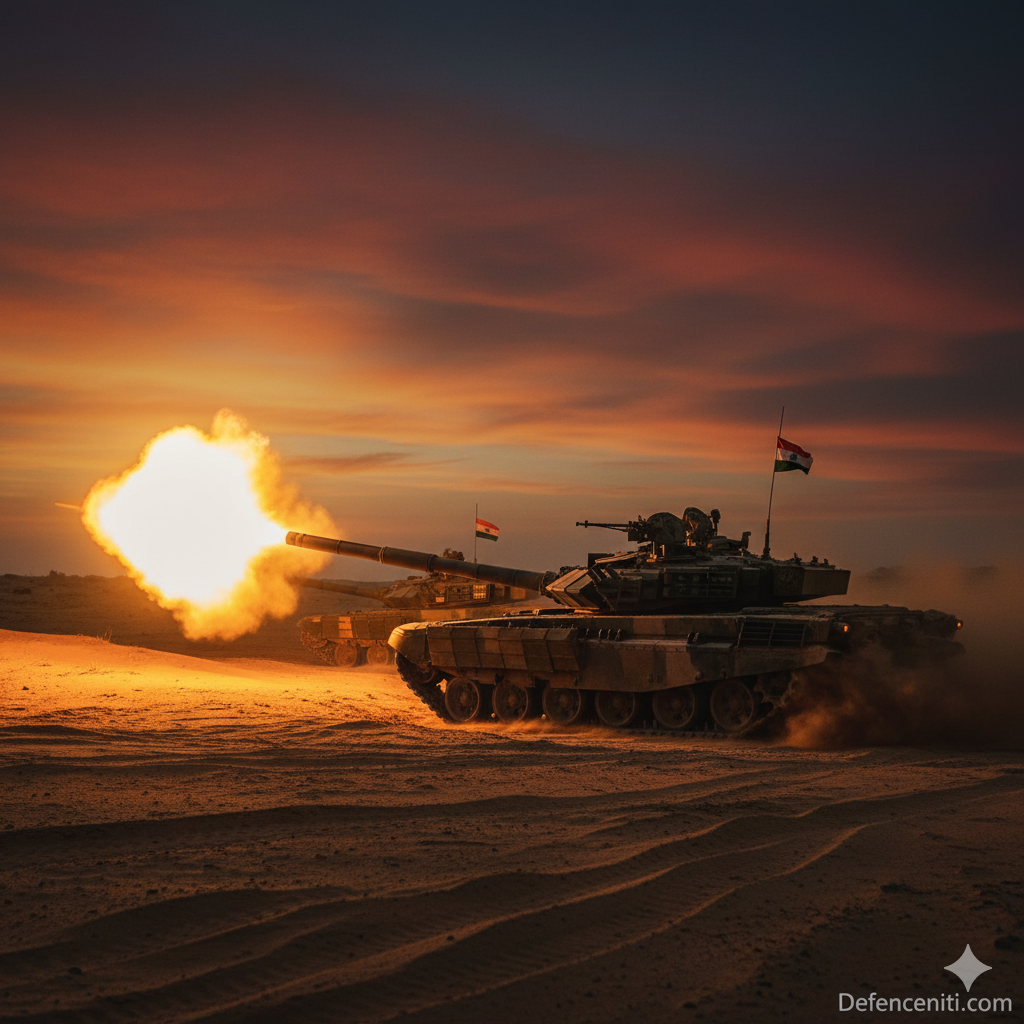
Firepower Upgrade: $236 Million Invar Missile Order Enhances T-90 Tank Lethality
In a major boost to the Indian Army’s mechanised forces, the Ministry of Defence has signed a ₹1,970 crore ($236 million) contract with Bharat Dynamics Limited (BDL) for the supply of more than 13,000 9M119M1 Invar-M1 (NATO: AT-11B Sniper) tank-fired anti-tank guided missiles, ensuring that India’s fleet of over 1,100 T-90S/SK Bhishma main battle tanks retains decisive overmatch against current and emerging armour threats along both western and northern borders.
The deal, inked on 14 November 2025 under the Buy (Indian) category, includes transfer of critical technologies for tandem warhead production and final integration at Ordnance Factory Medak (OFMK), marking another milestone in the progressive indigenisation of ammunition for Russian-origin platforms.
Contract Scope and Immediate Operational Impact
The procurement covers 13,200+ Invar-M1 missiles plus associated training simulators, handling equipment, and five years of product support. Deliveries will begin in 2026 and complete by early 2029, with peak production rate reaching 2,500 missiles per year at BDL’s new dedicated facility in Amravati, Maharashtra.
Each T-90 Bhishma regiment (45–62 tanks) typically carries 12–16 gun-launched missiles in ready racks, meaning this single order equips approximately 200–250 tank battalions with a full war-load plus one complete reload — sufficient to sustain high-intensity operations for several weeks without resupply. When combined with existing stocks and the previous 2019 contract for 10,000+ missiles, the Indian Army will possess one of the largest inventories of third-generation+ tank ATGMs in the world.
Invar-M1 Technical Breakdown: Still Lethal After All These Years
The 9M119M1 Refleks-M is a 125 mm gun-launched, laser beam-riding, fire-and-forget missile with a maximum range of 5,000 metres (effective engagement 4,500 m by day, 4,000 m by night). It features a tandem HEAT warhead capable of penetrating 900 mm RHA behind explosive reactive armour (ERA) — more than enough to defeat the frontal armour of Pakistan’s Al-Khalid, Al-Khalid-I, and even the latest VT-4 variants, as well as Chinese Type-96B and Type-99A tanks at combat ranges.
Key advantages over older second-generation missiles:
- True fire-and-forget after lock-on (semi-automatic command to line-of-sight with laser beam-riding guidance)
- Top-attack trajectory option against tanks fitted with advanced ERA/APS
- Flight time to 5 km: ~16 seconds (average speed 310 m/s)
- High resistance to existing soft-kill countermeasures
- Ability to engage low-flying helicopters (up to 4 km)
During Exercise Bharat Shakti in March 2024 at Pokhran, T-90s firing Invar missiles demonstrated repeated hits on moving targets at 4.2–4.8 km under dusty conditions, achieving a 94% first-round hit probability — performance that remains unmatched by global standards.
Why Invar Still Matters in 2025
While the DRDO-developed MPATGM (Man-Portable Anti-Tank Guided Missile) and Nag/CLGM (Cannon-Launched Guided Missile) are progressing well — as covered in our detailed MPATGM Milestone analysis — neither system is yet available in the quantities required for armoured formations. The MPATGM is infantry-centric with a 4 km range, while the CLGM programme for Arjun Mk-1A and future FRCV remains in advanced development.
Invar therefore continues to provide the only mature, mass-available, third-generation+ tank ATGM for the Army’s mechanised spearheads. The missile’s proven reliability in high-altitude Ladakh (successful trials at 15,000 ft) and desert, and plains environments makes it the backbone of anti-armour capability for the pivotal Strike Corps formations facing both Pakistan (I, II Corps) and China (southern Xinjiang and Tibet MDs).
Lessons from Ukraine: Survivability + Lethality = Dominance
The ongoing war in Ukraine has dramatically validated the continued relevance of heavy armour when properly supported. Russian T-90M tanks equipped with Relikt ERA, Arena-M active protection systems, and Invar-M1 missiles have consistently outperformed expectations against Javelin, NLAW, and drone threats.
India has taken note. The T-90 Bhishma fleet is receiving comprehensive upgrades including:
- Indigenous Kanchan-Modular ERA + NERA panels
- DRDO soft-kill suite (laser warning + smoke grenades)
- Integration of indigenous anti-drone electronic warfare suite and cage armour (detailed in our recent article T-90 Bhishma Anti-Drone Shield Upgrade)
- Planned integration of DRDO hard-kill APS (similar to Russian Afghanit) by 2028–29
With the fresh Invar-M1 stock, a modernised T-90 Bhishma can engage enemy armour beyond the effective range of most tank guns (3–3.5 km) while remaining largely immune to top-attack threats through its upgraded protection suite — creating the kind of asymmetric advantage India requires in potential high-intensity conflict.
Production, Indigenisation and Export Angle
BDL has progressively increased indigenous content from ~35% in the first batch (2003–2010) to over 70% in the current contract. Critical components now manufactured in India include the tandem warhead (High Energy Materials Research Laboratory, Pune), guidance unit (Research Centre Imarat, Hyderabad), solid propellant motor, and thermal batteries.
The Amravati facility, inaugurated in 2024, is designed for 3,000+ missiles per year and will also produce the air-launched Helina/Dhruvastra and stand-off Nag variants on the same production lines — creating significant economies of scale.
Export potential is real. Armenia, which already operates Indian Akash-NG and Pinaka systems, has shown strong interest in Invar for its T-90S fleet. Similar inquiries have come from Vietnam and several African nations operating Russian-origin tanks.
Future Roadmap: Beyond Invar
While Invar provides the bridge, the long-term plans remain firmly focused on complete indigenisation. The DRDO Cannon-Launched Laser-Guided Missile (CL-LGM) with 8+ km range and IIR seeker is expected to begin user trials in 2027–28 for integration on T-90MS (the upgraded variant India plans to licence-build) and the Future Ready Combat Vehicle (FRCV).
A parallel SAMHO missile development — a 6–8 km gun-launched missile with millimetre-wave active seeker — is also progressing and could eventually replace Invar entirely by 2032–33.
Conclusion: Firepower Multiplier for Strike Corps
The Invar-M1 contract ensures that India’s armoured formations retain their ability to deliver decisive shock action deep into enemy territory. A single T-90 regiment equipped with 50+ missiles can theoretically neutralise an entire enemy armoured brigade in the opening hours of battle — a capability that deters adventurism on both fronts.
When combined with upgraded fire-control systems, third-generation thermal imagers (Catherine-FC from BEL-Thales), and networked battle-management systems being rolled out under Project Sanjay, the T-90 Bhishma with Invar-M1 remains a formidable platform well into the 2030s.
Conclusion: Prudence, Not Panic
This $236 million investment is not about replacing indigenous systems — it is about ensuring zero capability gaps while those systems mature. In an era where adversaries are fielding ever-more advanced armour and active protection, India has chosen to keep its existing 1,100+ T-90s decisively lethal rather than risk a temporary dip in combat power.
The message to potential adversaries is unambiguous: India’s mechanised forces can not only stop an armoured thrust — they can annihilate it at stand-off ranges, day or night, in any terrain.
With fresh missiles flowing into ammunition depots from 2026 onward, the Bhishma fleet just became significantly more dangerous.