
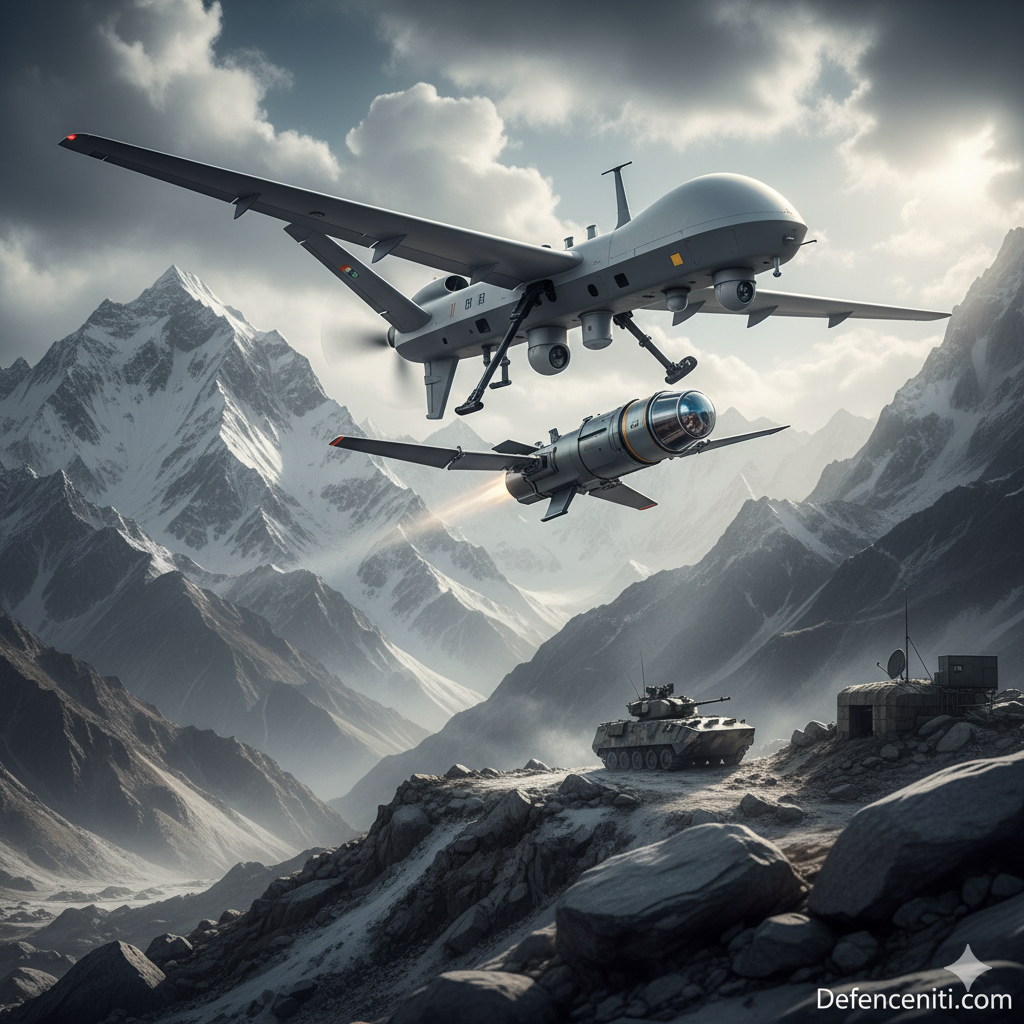
DRDO’s ‘Jishnu’ Miniature Missile Debut: Drone-Delivered Precision Strikes Redefine Tactical Warfare
At the India International Trade Fair (IITF) 2025, the Defence Research and Development Organisation (DRDO) unveiled its latest innovation: the ‘Jishnu’ miniature loitering munition, a compact, drone-delivered precision strike weapon poised to transform tactical operations along India’s contested borders.
In a packed hall at Pragati Maidan, DRDO Chief Dr Samir V Kamat and Bharat Dynamics Limited (BDL) executives demonstrated the system’s capabilities to an audience of military brass, international delegates, and defence startups. The 15-kg Jishnu, with its 10-15 km engagement range and man-in-the-loop guidance, promises to deliver anti-armour lethality without the risks of manned platforms, addressing vulnerabilities exposed in recent skirmishes along the Line of Actual Control (LAC) and Line of Control (LoC).
The Birth of Jishnu: From Concept to Combat-Ready
Project Jishnu, greenlit in 2022 under DRDO’s Tactical Systems Division, emerged as a direct response to the proliferation of low-cost drones in asymmetric warfare. Drawing lessons from the Nagorno-Karabakh conflict and Ukraine’s theatre, where loitering munitions like the Israeli Harop and Turkish Kargu decimated armoured columns, Indian engineers aimed to indigenize a similar capability tailored for high-altitude and desert environments.
At its core, Jishnu is a tube-launched, rotary-wing loitering munition with a 30-minute endurance and a 2-kg high-explosive warhead optimized for top-attack profiles against tanks and bunkers. Its electro-optical/infrared (EO/IR) seeker allows real-time video feed to operators, enabling abort-and-reloiter options mid-flight. Integration with the Uttam AESA radar for beyond-line-of-sight targeting further enhances its versatility.
BDL, the nodal production agency, has already cleared initial qualification trials in Rajasthan’s Pokhran ranges, where Jishnu neutralized mock T-72 equivalents at 12 km under simulated LoC conditions. Production scaling is underway at BDL’s Hyderabad facility, with the first user trials slated for Q1 2026 with the Indian Army’s Northern Command.
Seamless Synergy with UAV Platforms: The Tapas-BH Edge
What sets Jishnu apart is its seamless integration with unmanned aerial vehicles (UAVs), turning them into airborne artillery. The system’s primary carrier is the DRDO-developed Tapas-BH-201 Medium Altitude Long Endurance (MALE) UAV, which can deploy up to four Jishnus in a single sortie. During a live demo at IITF, a scale-model Tapas-BH released a Jishnu surrogate that homed in on a projected armoured target with pinpoint accuracy.
This drone-missile tandem addresses key operational gaps. Tapas-BH, with its 25-hour endurance and 225 kg payload, provides persistent ISR (Intelligence, Surveillance, Reconnaissance) over the LAC, feeding coordinates to Jishnu swarms for synchronized strikes. As highlighted in our recent coverage of Exercise Trishul 2025, where Tapas-BH swarms delivered real-time targeting data to amphibious forces, such integrations are proving pivotal in tri-service exercises.
Future upgrades include compatibility with the stealthy Ghatak UCAV, detailed in our in-depth analysis here. Ghatak’s autonomous strike profile could enable Jishnu launches in contested airspace, evading Chinese HQ-9 SAMs and J-20 fighters.
Countering Evolving Threats: Anti-Armour in a Drone-Saturated Battlefield
India’s borders are increasingly drone-infested. Chinese DJI clones and Turkish Bayraktar TB2s have probed Indian defences, underscoring the need for affordable, attritable countermeasures. Jishnu flips the script, offering offensive precision at a fraction of the cost — estimated at ₹15-20 lakh per unit versus ₹5 crore for a Spike NLOS missile.
Its anti-armour focus is critical. The tandem warhead penetrates 800mm RHA equivalent, sufficient for most Pakistani Al-Khalid and Chinese Type-99 tanks. In high-altitude trials at Ladakh, Jishnu maintained stability at 15,000 feet, a feat validated against the MPATGM’s desert successes, as reported in our MPATGM Milestone article.
Moreover, Jishnu’s loitering capability allows it to suppress enemy air defences (SEAD) by drawing fire, buying time for larger strikes. This layered approach complements the Army’s ongoing T-90 upgrades with anti-drone shields, explored in this piece.
Technological Backbone: Indigenous Innovation at Play
Jishnu embodies Atmanirbhar Bharat’s ethos, with 85% indigenous content. Key subsystems include the Sakthi solid-fuel motor from Vikram Sarabhai Space Centre (VSSC), inertial navigation from Research Centre Imarat (RCI), and AI-enhanced seeker algorithms from the Centre for Artificial Intelligence and Robotics (CAIR).
DRDO’s collaborative model shines here: iDEX startups contributed swarm logic for coordinated Jishnu flights, while private firms like Tonbo Imaging supplied the EO/IR gimbals. This mirrors the tech transfer successes at Samanvay 2025, where over 50 innovations moved from lab to line.
Export potential is equally promising. With MTCR compliance, Jishnu eyes markets in Southeast Asia and Africa, where nations grapple with similar insurgent drone threats. Early inquiries from Vietnam and the Philippines — fresh off BrahMos deals — suggest a foothold in the $10 billion loitering munition market by 2030.
Strategic Ramifications: Reshaping Border Dynamics
Deployed in platoons along the LAC, Jishnu could deter Chinese salami-slicing by enabling rapid, low-signature responses to incursions. Imagine a Tapas-BH patrol spotting PLA mechanized patrols in Arunachal; within minutes, a Jishnu quartet neutralizes lead vehicles, forcing a retreat without escalating to artillery duels.
On the LoC, it counters Pakistan’s Nasr tactical nukes by offering non-nuclear precision against forward deployments. Integrated with Project Kusha’s long-range SAMs — as outlined here — it forms a denial bubble over key chokepoints like Galwan Valley.
Broader implications extend to counter-terror ops in Kashmir, where Jishnu’s precision minimizes collateral damage compared to unguided rockets. The Army plans 500-unit inductions by 2027, with Navy and Air Force variants for carrier-based and fighter-launched roles.
Challenges Ahead: From Prototype to Proliferation
Yet, hurdles remain. Electronic warfare (EW) resilience against Chinese jammers is a work-in-progress, with DRDO testing fibre-optic datalinks. Supply chain bottlenecks for rare-earth seekers could delay scaling, though Samanvay initiatives aim to mitigate this.
Operator training is another focus: The Army’s Drone Warfare School at Beas will incorporate Jishnu simulations by mid-2026. International collaborations, like joint trials with Israel on Harpy-J integrations, could accelerate maturation.
Conclusion: Precision in the Skies of Uncertainty
The Jishnu debut at IITF 2025 is more than a tech reveal — it’s a declaration of India’s tactical evolution. In an era where drones democratize destruction, Jishnu ensures India wields the sharper edge. As Dr Kamat noted, “Jishnu doesn’t just strike; it thinks, adapts, and survives.”
With borders aflame and skies contested, this miniature marvel heralds a future where precision, not payload, wins wars. Watch this space: Jishnu’s first combat deployment could redefine South Asian security before the year ends.


Pingback: DRDO Unveils ‘Gaurav’ Glide Bomb for Su-30MKI - DefenceNiti.com