
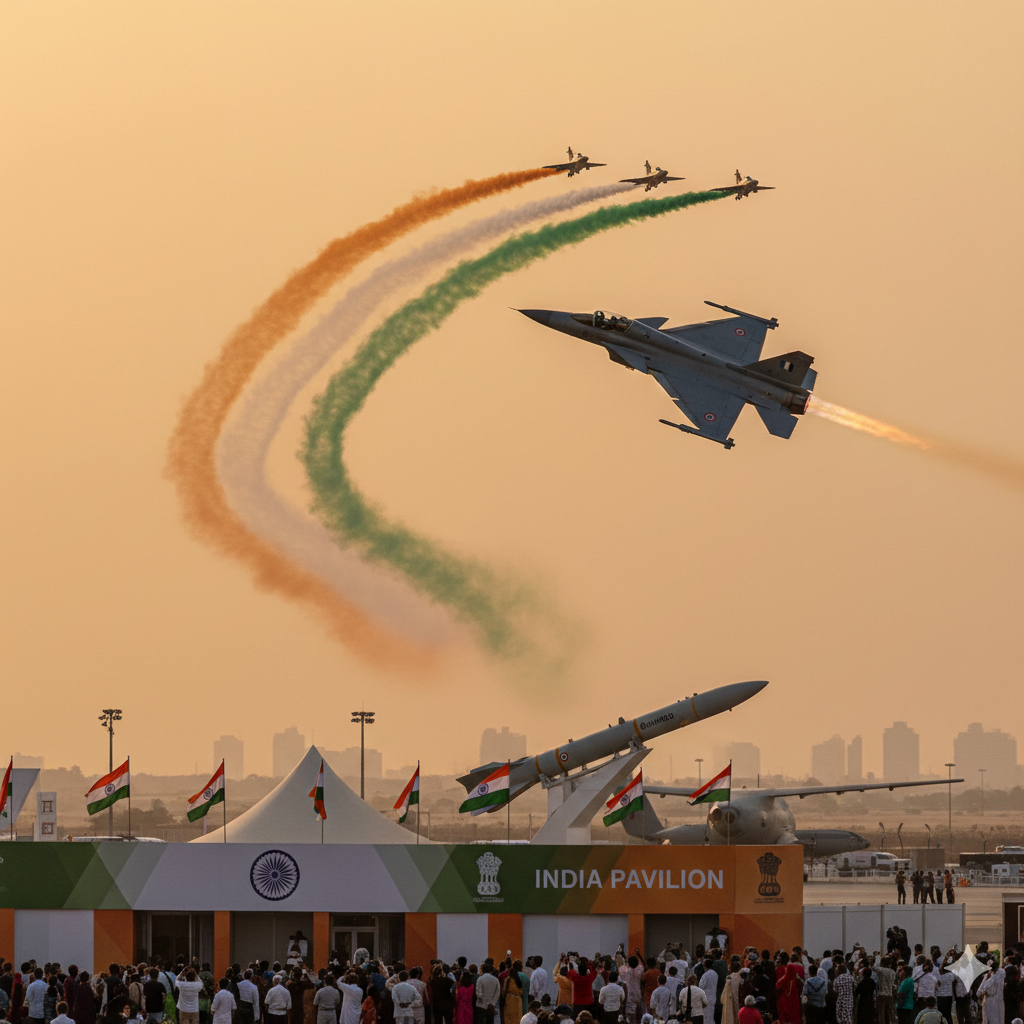
India’s Bold Export Push at Dubai Airshow 2025: Tejas Fighters and BrahMos Missiles Take Center Stage
Dubai, 18 November 2025 – As the Dubai Airshow 2025 opened its gates on 17 November at Al Maktoum International Airport, India has mounted its most ambitious international defence showcase to date, signalling an unmistakable intent to transition from the world’s largest arms importer to a serious global exporter.
Minister of State for Defence Sanjay Seth formally inaugurated the expanded India Pavilion on Day 1, declaring that “India is no longer just a buyer in the global arms bazaar — we are now a credible, competitive supplier.” The pavilion, one of the largest national displays at the show, hosts 19 established Indian defence companies and 15 iDEX startups, covering a record footprint that is almost 40 percent larger than India’s 2023 presence.
Tejas Roars Over Dubai Skies
The star attraction, both in the air and on the static park, is undoubtedly the Light Combat Aircraft (LCA) Tejas Mk1A. While the Indian Air Force’s Suryakiran Aerobatic Team (SKAT) delivered a breathtaking 30-minute routine with their Hawk Mk132 aircraft on 17 November, a single-seat Tejas performed solo high-performance manoeuvres that drew prolonged applause from the crowds and serious attention from delegations.
HAL officials confirmed that the Tejas on display is a full-combat-capable Mk1A variant equipped with Uttam AESA radar, EL/M-2052 radar option, ASRAAM, Astra BVR missiles, and the full suite of Indian-made electronic warfare systems. Visitors from Saudi Arabia, UAE, Egypt, Argentina, and several Southeast Asian nations spent extended time in the Tejas cockpit simulator, with multiple air forces requesting detailed technical briefings and price quotations.
The timing could not be better. HAL has now delivered the first three Tejas Mk1A aircraft to the IAF and is ramping up production to 24 aircraft per year by 2027. With 83 Mk1A already on firm order for the IAF and another 97 in the pipeline, the production line is mature enough to absorb export orders without affecting domestic requirements — a key concern that has held back previous export campaigns.
BrahMos: The Supersonic Deal-Maker
If Tejas is the show-stopper in the air, BrahMos is the undisputed king on the ground. The dedicated BrahMos Aerospace chalet has been packed since opening, with a constant stream of Gulf, African and Southeast Asian delegations. The air-launched BrahMos-NG model (800 kg, foldable wings, Su-30MKI compatible) received particular attention after the Philippines became the first export customer for the ground-launched variant in 2022.
BrahMos CEO & MD Dr Sudhir Kumar Mishra told DefenceNiti that “we are in advanced negotiations with three Middle Eastern countries and two Southeast Asian nations for the air-launched variant.” Industry sources indicate Saudi Arabia and UAE have shown strong interest in both air- and ship-launched versions, while Vietnam and Indonesia continue technical evaluations.
The missile’s proven 600+ km range (export version extended to 800 km under MTCR waiver conditions India now enjoys) and its ability to be integrated on multiple platforms — Su-30MKI, MiG-29K, Tejas, warships, submarines, and mobile land launchers — makes it uniquely attractive to fill capability gaps that Western suppliers cannot or will not meet due to political restrictions.
Beyond Tejas and BrahMos: A Complete Ecosystem on Display
The India Pavilion is deliberately structured to demonstrate an entire ecosystem rather than isolated products. DRDO is showcasing the Akashteer air defence command system, QRSAM, MPATGM, and the new Loitering Munition ‘Jishnu’. Bharat Dynamics Limited (BDL) has brought the full range of Astra BVR missiles (Mk1, Mk2, Mk3 under development), Konkurs-M anti-tank missiles, and the new 4th-generation SAMAR air defence system made from repurposed R-27 air-to-air missiles.
Tonbo Imaging, IdeaForge, and NewSpace Research are demonstrating advanced optronics, swarm drones, and anti-drone systems that have already seen battlefield use along the LAC. iDEX winners are displaying innovations ranging from AI-based radar signal processing to 3D-printed titanium components for aero-engines — tangible proof that India’s defence startup ecosystem has moved from PowerPoint to production.
Strategic Messaging to the Gulf
The choice of Dubai Airshow for this aggressive export push is deliberate. The Gulf region represents the fastest-growing defence market outside the Indo-Pacific, with Saudi Arabia, UAE, Qatar, and Egypt collectively planning to spend over $150 billion on new equipment in the next decade. India offers three advantages Western suppliers increasingly cannot match: competitive pricing (Tejas is priced at roughly $50–65 million versus $80–110 million for Gripen-E/F-16 Block 70), full technology transfer, and zero political strings.
Minister Seth’s bilateral meetings with his UAE counterpart and the Saudi Minister of Defence on the sidelines have already produced an agreement to deepen joint training, co-development, and regular defence industry working group meetings. Sources indicate the UAE is seriously evaluating the Tejas as a potential complement to its Rafale and F-35 fleet, while Saudi interest centres on BrahMos coastal defence batteries and Akash-NG air defence systems.
From Importer to Top-10 Exporter: The Numbers Tell the Story
India’s defence exports have grown from ₹686 crore in 2016–17 to ₹23,622 crore in 2024–25 — a 34-fold increase in eight years. The target for 2029–30 is ₹50,000 crore ($6 billion). Dubai Airshow 2025 is the launchpad to breach that target. HAL alone has exported Do-228 aircraft to Guyana and is in talks with multiple nations for ALH Dhruv helicopters and LCH Prachand attack helicopters.
The presence of senior delegations from Malaysia, Philippines, Vietnam, Egypt, Nigeria, Botswana, and Argentina at the India Pavilion is not coincidental. These are exactly the countries that have either placed orders or are in final stages of negotiation for Indian platforms.
Conclusion: A Defining Moment
As the Suryakiran team painted the Dubai sky in tricolour smoke and the Tejas roared overhead on 17 November, the message was unmistakable: India has arrived as a defence exporter. The combination of combat-proven platforms, mature production lines, aggressive pricing, full ToT, and strategic autonomy is proving irresistible to nations seeking alternatives to traditional suppliers.
If even one major contract — whether Tejas for Egypt, BrahMos for Saudi Arabia, or Akash-NG for UAE — is announced before the show closes on 21 November, Dubai Airshow 2025 will be remembered as the moment India definitively entered the global top-10 defence exporters club.
The future of Indian defence exports is not coming — it is already here, flying supersonic over the Dubai desert.
Pingback: Astra’s Extended Reach: 250-km Variant and Su-57 Offers Signal IAF’s Next-Gen Air Superiority Push - DefenceNiti.com